

How to Price Design Work: Why It Feels So Hard
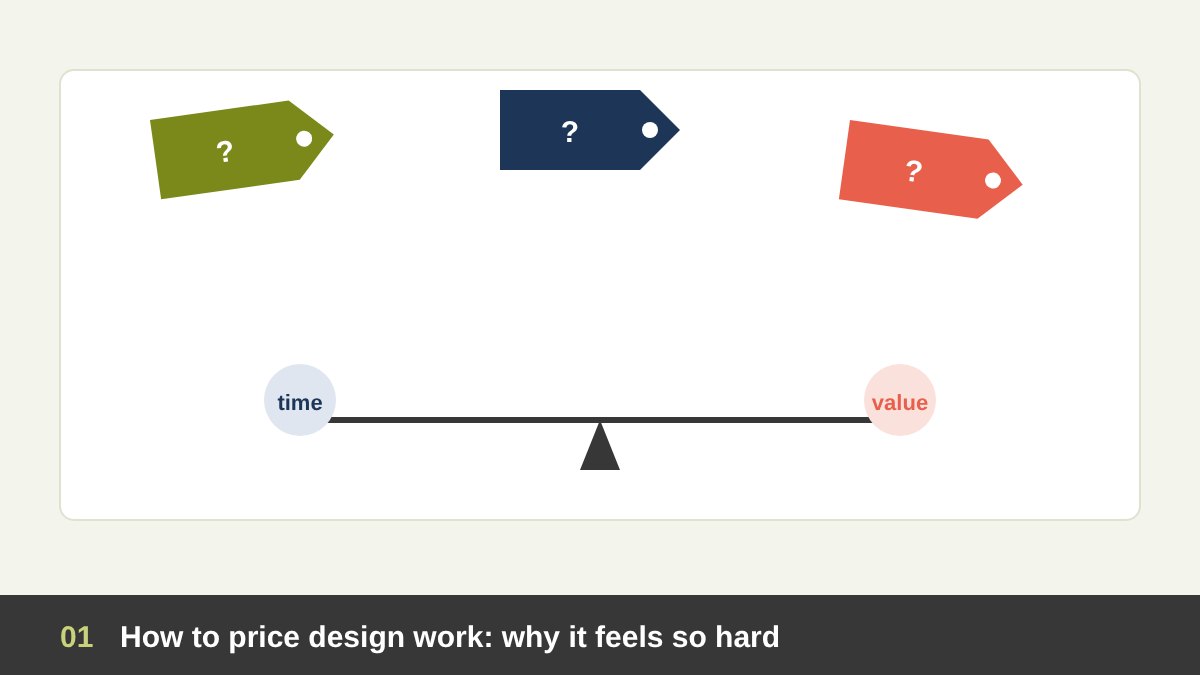
Ask a room of designers what is the hardest part of their job, and many will not say concepts, software or difficult clients. They will say pricing. How much should a logo cost? Should I charge per hour or per project? Why did that client accept my price immediately, and was I too cheap? Why did another client disappear after seeing my quote?
Pricing feels hard because design is not a product on a shelf. Two logos can take the same number of hours and be worth completely different amounts to two different businesses. Many designers, especially at the start, also feel uncomfortable talking about money, so they guess, copy what others charge, or lower their price at the first sign of hesitation.
After more than twenty years as a designer, art director and studio founder, I have learned that pricing is a skill like any other. It has a method. This guide explains how to price design work: how to calculate your minimum rate, the main pricing models (hourly, project and value-based), how to estimate, how to define scope and revisions, how to write a quote, how to set payment terms, and how to raise your prices with confidence.
Key takeaways
- Pricing is a design decision, not a guess. Start from your real numbers: your costs, the income you need and the hours you can actually bill. Your minimum rate comes from that calculation, not from what other people charge.
- There are three main ways to price design work: hourly (you sell time), project-based (you sell a defined result) and value-based (you price according to what the result is worth to the client). Most experienced designers use a mix.
- The price is only as clear as the scope. Every quote should state exactly what is included, how many revision rounds, what usage rights the client gets and what happens with extra requests.
- Protect your work with payment terms: a deposit before you start, milestone payments on larger projects and final files released after the final payment.
- Below you will find how to calculate your rate, each pricing model with its pros and cons, a comparison table, estimating, scope, revisions, usage rights, packages, proposals, payment terms, local and international clients, raising prices, free work, mistakes and a checklist.
What You Are Really Selling: Time, Results or Expertise
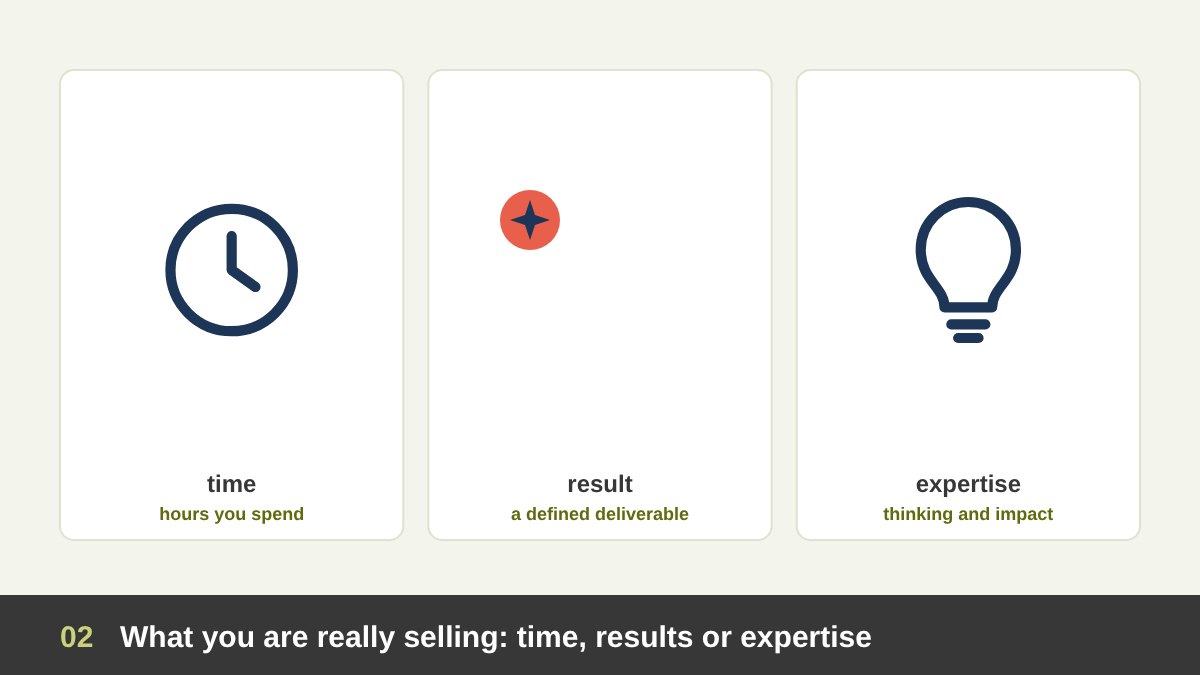
Before choosing a pricing model, decide what you are actually selling. You can sell time: the client pays for the hours you spend. You can sell a result: the client pays for a defined deliverable, such as a logo set or a ten-page website, regardless of how long it takes. Or you can sell expertise and impact: the client pays for your thinking and for the business value your work creates.
Each view leads to a different model. Selling time leads to hourly pricing. Selling results leads to project pricing. Selling impact leads to value-based pricing. None of them is morally better; they fit different stages of a career and different types of work.
What matters is to understand that the client is never really buying hours of software. They are buying a solution: a brand that looks credible, a website that brings enquiries, a presentation that wins a contract. The closer your pricing is to that solution, the easier it becomes to justify and the less you are compared with the cheapest offer on the internet.
Know Your Numbers: Calculating Your Minimum Rate
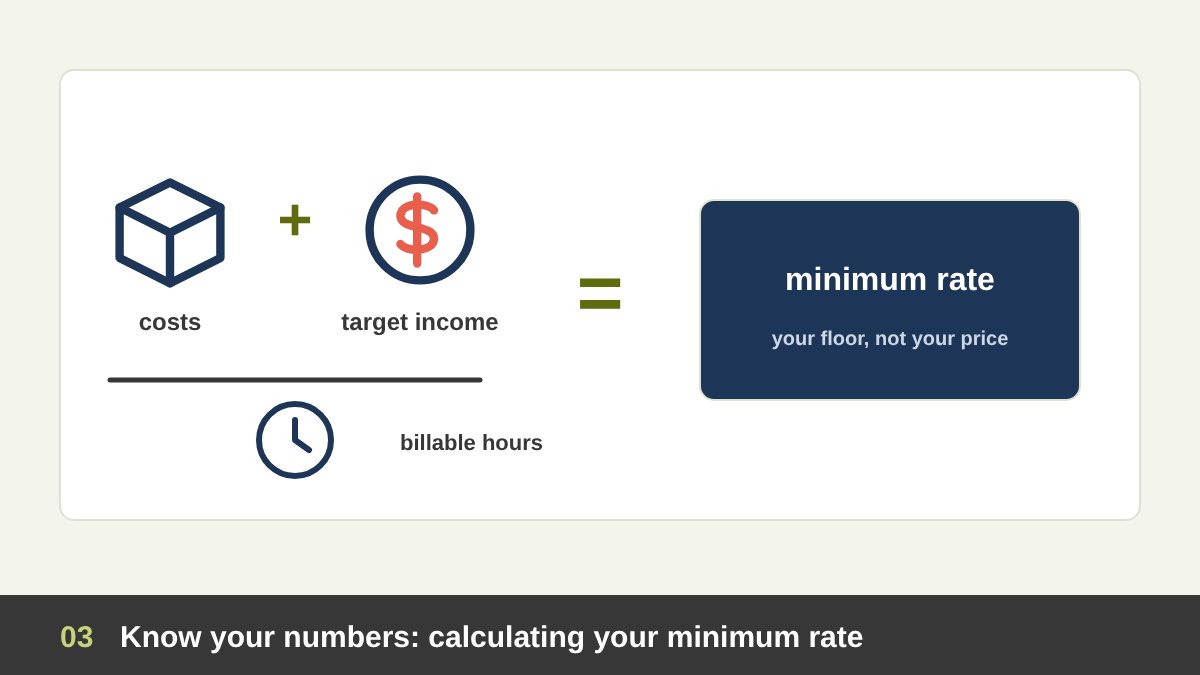
Every pricing strategy starts with one number: your minimum rate, the rate below which you lose money. To find it, add up your yearly costs: computer and equipment, software subscriptions, fonts and stock images, internet, workspace, transport, accounting, taxes and insurance. Then add the income you need to live, save and grow.
Next, estimate your billable hours. This is where most beginners make a serious mistake. You will not bill forty hours a week. A large part of your time goes to emails, meetings, proposals, admin, learning, marketing and unpaid gaps between projects. Many freelancers find that only about half to two-thirds of their working time is actually billable. Be honest here.
The formula is simple: (yearly costs + target income) ÷ billable hours per year = minimum hourly rate. For example, if your costs and target income together come to 600,000 in your currency and you can bill about 1,000 hours a year, your minimum is 600 per hour. This is not your price; it is your floor. Every quote you send, whatever the model, should be checked against it.
Hourly Pricing: How It Works, Pros and Cons
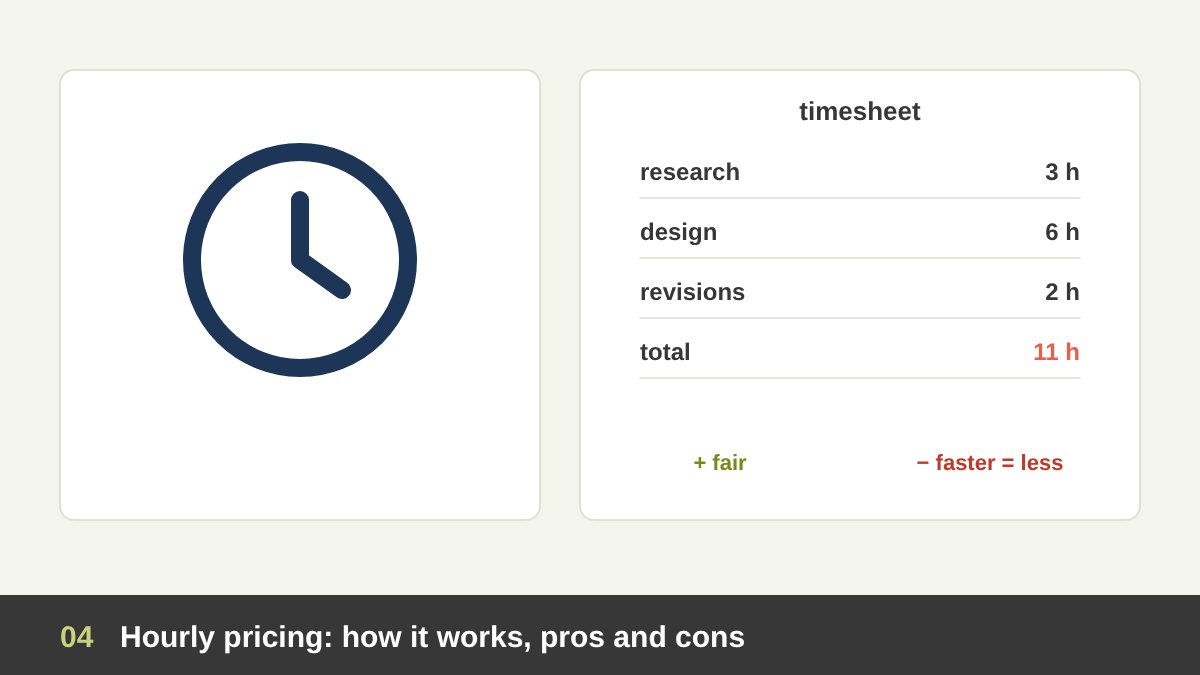
With hourly pricing, you charge an agreed rate for every hour you work and send the client a timesheet. It is simple, transparent and fair when the scope is unclear: if the client keeps adding requests, you are paid for the extra time. That is why hourly pricing suits ongoing tasks, small edits, consulting, art direction support and projects where nobody can predict the effort.
The problems appear as you get better. The faster and more experienced you become, the less you earn for the same result. A logo concept that took a beginner ten hours might take you three, because of years of practice, yet hourly pricing pays you less for it. Clients may also focus on the hours instead of the result, question every line of the timesheet, or hesitate to call you because the meter is always running.
If you use hourly pricing, give an estimated range before you start (“between 8 and 12 hours”), track your time accurately, and agree to warn the client before exceeding the estimate. Never use your hourly rate as a reason to work slowly, and never hide time: trust is the whole basis of this model.
Day Rates and Retainers: Pricing Ongoing Work
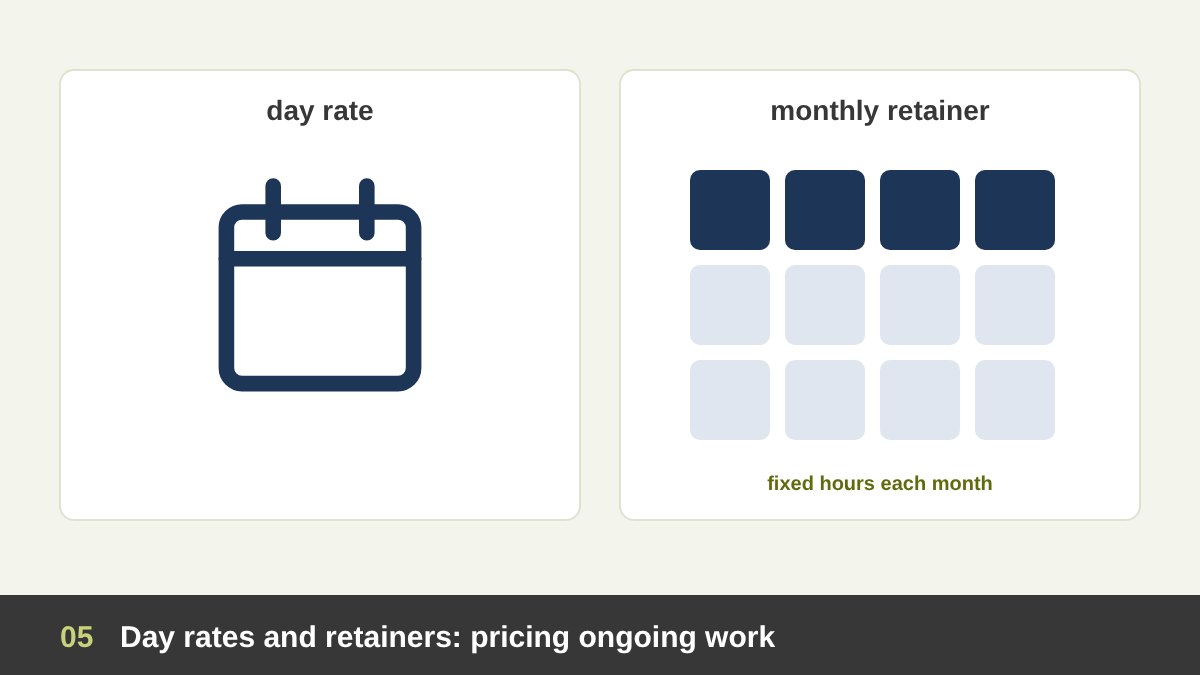
A day rate is hourly pricing in larger units: the client books you for a full or half day. It works well for workshops, on-site art direction, photo shoots and intensive design sprints. It reduces the feeling of a running meter and usually includes a small saving compared with charging every hour separately.
A retainer is a monthly agreement: the client pays a fixed amount every month for a defined amount of work or availability, such as a set number of hours, a set number of social media designs, or ongoing brand support. Retainers give the designer stable income and give the client priority access and a designer who already understands the brand.
A retainer needs clear rules: what is included each month, what happens to unused hours (I usually let them expire, or allow a limited carry-over), how quickly you respond, and how extra work is charged. Without these rules, a retainer slowly becomes unlimited work for a fixed price. For brand work, a retainer is also an excellent way to keep everything consistent, as I explain in brand consistency.
Project-Based Pricing: One Price for a Defined Result
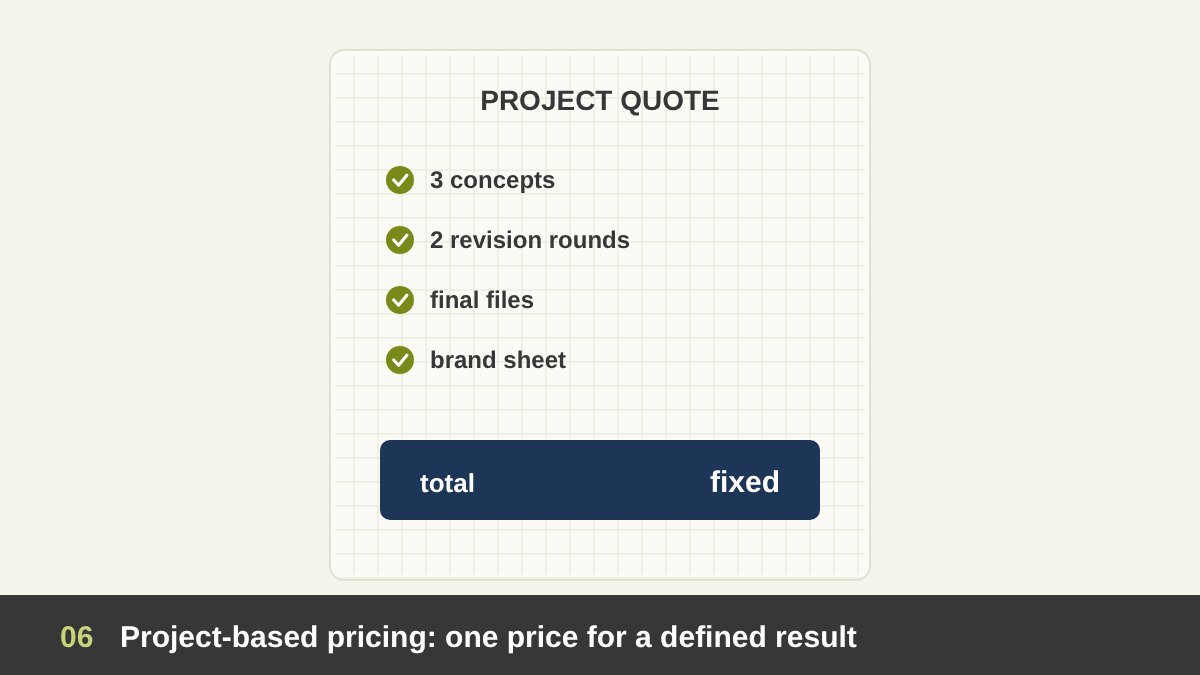
With project-based pricing, also called fixed or flat pricing, you quote one price for a clearly defined result: “a logo identity with three initial concepts, two revision rounds and final files”, or “a five-page bilingual website”. The client knows the total in advance, which makes it easier to approve and budget, and you are rewarded for working efficiently.
Internally, a project price is still built on your numbers. Estimate the hours for each phase (research, concepts, revisions, final files, project management), multiply by your rate, add a buffer for the unexpected, and then compare the total with the value of the project and the market. If the value is clearly higher, you can price higher; if the total is far above what the client can pay, adjust the scope, not just the price.
The risk of project pricing is scope creep: small extra requests that slowly turn a fixed project into an endless one. The protection is a precise scope and a clear process for changes. This is why project pricing and a good design brief always go together.
Value-Based Pricing: Pricing the Outcome, Not the Hours
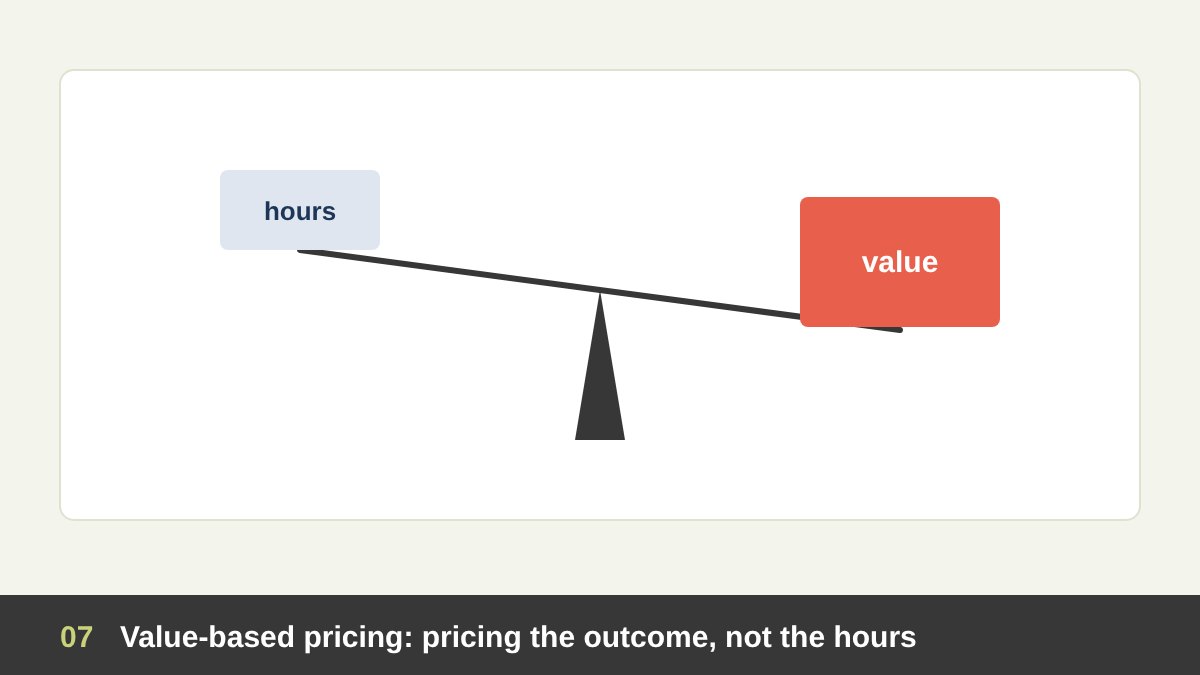
Value-based pricing sets the price according to the value the design creates for the client, not the time it takes. A logo for a local café and a logo for a company about to launch nationally may take similar effort, but their value is very different: the second will appear on products, vehicles and advertising seen by millions, and a weak identity would cost far more than the design fee.
To price by value, you must understand the client’s business: what the project is expected to achieve, what success is worth, what the cost of failure is, and how long the result will be used. This comes from good questions in the briefing meeting: “What would a successful launch mean for your business?”, “How long do you expect to use this identity?”, “Where will it appear?”.
Value-based pricing works best for strategic, high-impact work such as brand identities, rebrands, campaign concepts and key presentations, and for designers with experience and a strong portfolio. It is not about charging as much as possible; it is about connecting your fee to the client’s return. A fee that is a small fraction of the expected value is easy to accept, even when it is higher than an hourly calculation would suggest.
Hourly vs Project vs Value: Which Pricing Model Should You Use?
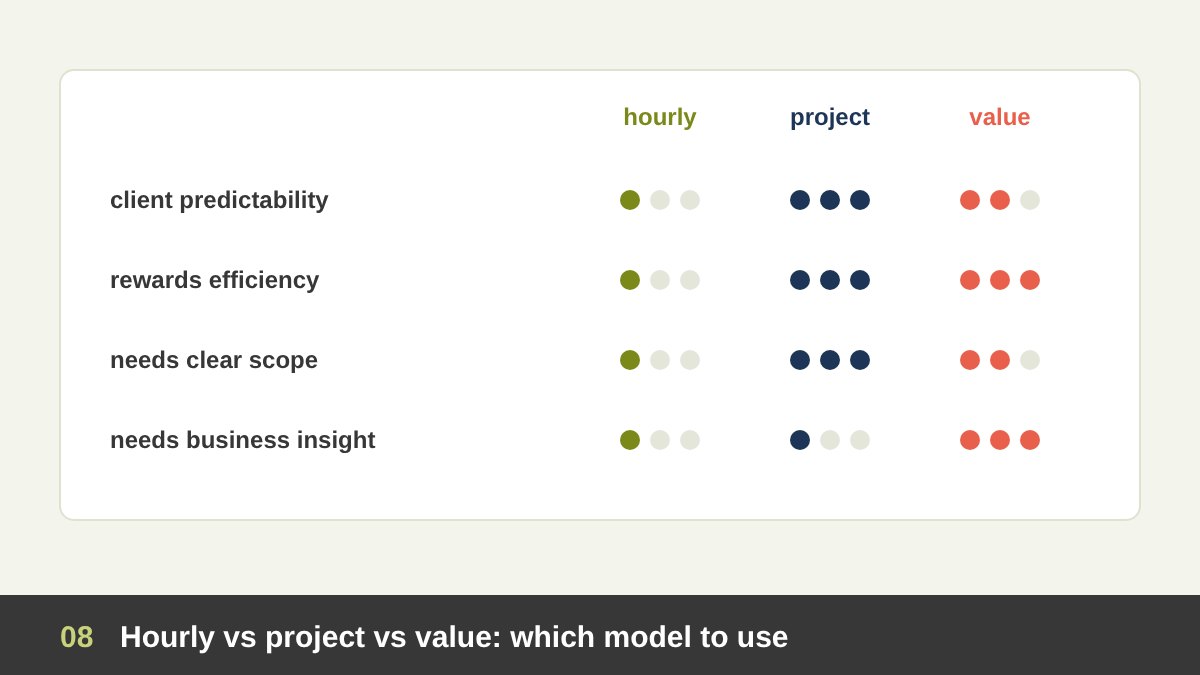
There is no single right model. In practice, most experienced designers combine them. I use project pricing for most defined work such as identities, websites and print, hourly or day rates for small edits, consulting and art direction support, and a value-based approach for strategic projects where the business impact is large and clear.
Choose by the type of work and the clarity of scope. Clear scope and defined deliverables: project pricing. Unclear or changing scope: hourly, at least for a first discovery phase. High strategic value and a client who sees design as an investment: value-based. Ongoing needs: a retainer.
Whatever model you choose, always calculate the hourly equivalent in the background. If a project price ends up far below your minimum rate, the model is not the problem; the price is. The table below compares the main models side by side.
| Pricing model | How it is calculated | Best for | Advantage | Risk |
|---|---|---|---|---|
| Hourly | Rate × hours worked, with a timesheet | Small edits, consulting, unclear scope | Fair when scope changes; simple | Earn less as you get faster; clients watch the clock |
| Day rate | Fixed price per full or half day | Workshops, shoots, on-site art direction | Simple booking; less clock-watching | Days can stretch; needs clear daily scope |
| Retainer | Fixed monthly fee for defined work or hours | Ongoing brand, social or design support | Stable income; deep brand knowledge | Becomes unlimited work without clear rules |
| Project (fixed) | Estimated hours × rate + buffer, adjusted for value | Defined deliverables: identity, website, print | Client knows the total; rewards efficiency | Scope creep if scope is vague |
| Value-based | A fair share of the value the result creates | Strategic, high-impact work: rebrands, launches | Fee linked to impact, not hours | Needs business understanding and trust |
| Packages | Three defined scopes at three price levels | Logos, identities, social media, websites | Easy choice; shows value | Must keep each tier profitable |
How to Estimate a Design Project
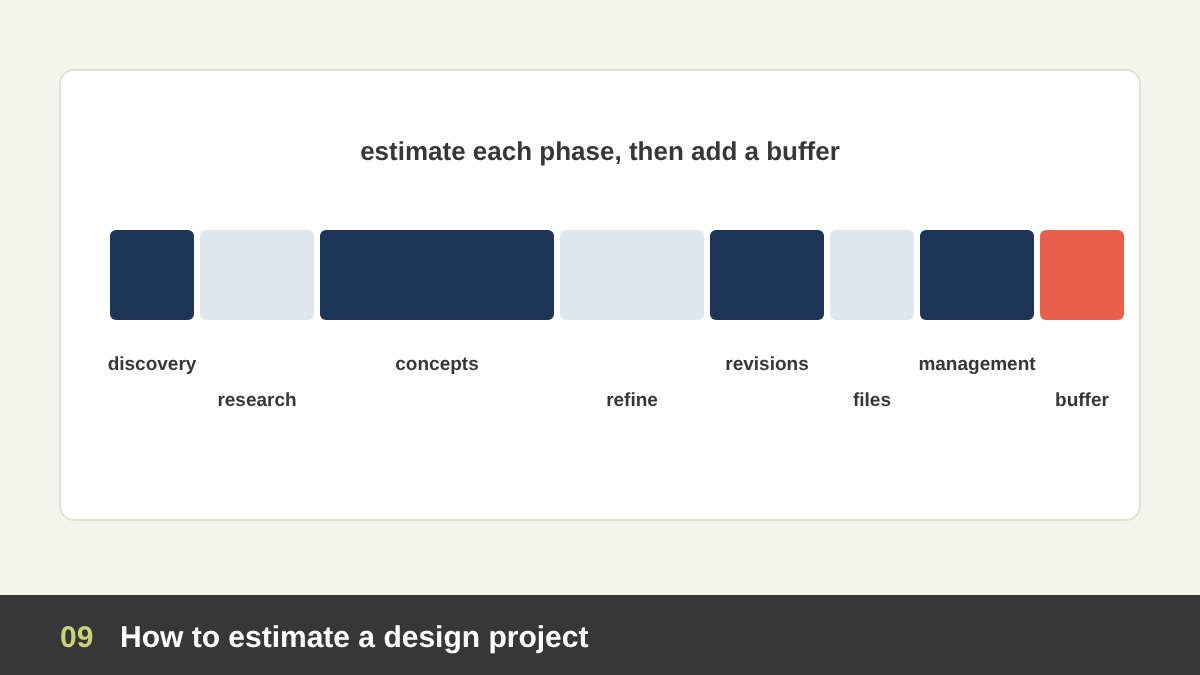
Accurate pricing depends on accurate estimating. Break the project into phases: discovery and briefing, research, concept development, refinement, revisions, final artwork and file preparation, and project management, which includes meetings, emails and presentations. Estimate the hours for each phase separately; it is much more accurate than guessing the whole.
Use your own history. If you track your time on every project, even when you do not charge hourly, you will quickly learn how long things really take. Most designers underestimate revisions, file preparation and communication. Those invisible hours are often a third of the project.
Then add a buffer, usually 10 to 20 percent, for the unexpected: a delayed decision, an extra meeting, a technical problem. This is not padding; it is realism. Finally, check the total against your minimum rate and the value of the project, and present the final price, not the calculation, to the client.
Scope: What Is Included and What Is Not
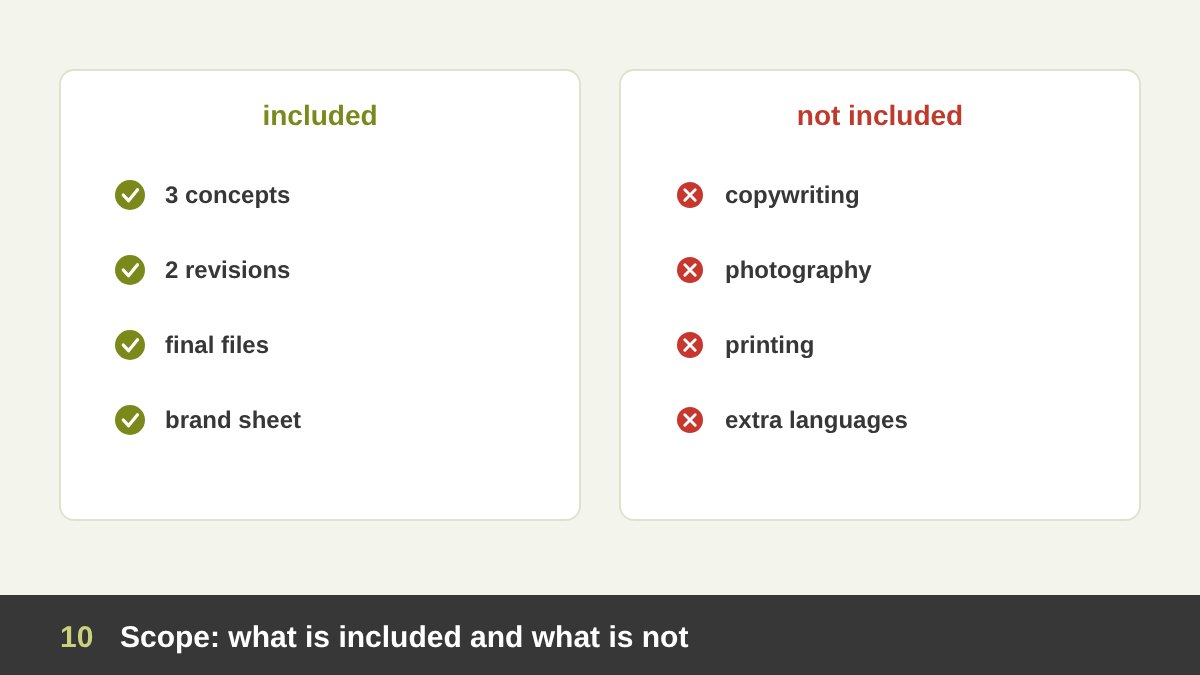
The scope defines exactly what the client receives for the price. A good scope lists the deliverables, the number of concepts, the number of revision rounds, the file formats, the languages and the timeline. Just as important, it lists what is not included: copywriting, photography, stock image licences, printing, website hosting, extra sizes or languages.
A clear “not included” list prevents most conflicts. Clients are not usually trying to take advantage; they simply do not know what is normal in design. If they assume that the logo price includes business cards, social media templates and a brand book, they will be disappointed when you charge for them. Saying it upfront makes the conversation easy.
When the client asks for something outside the scope, do not refuse and do not do it silently. Reply with a short change request: what the new request is, how much it costs and how it affects the timeline. Many clients will accept it immediately. If the requests become unreasonable, read when to say no as a designer.
Revisions: How Many and What Counts as One
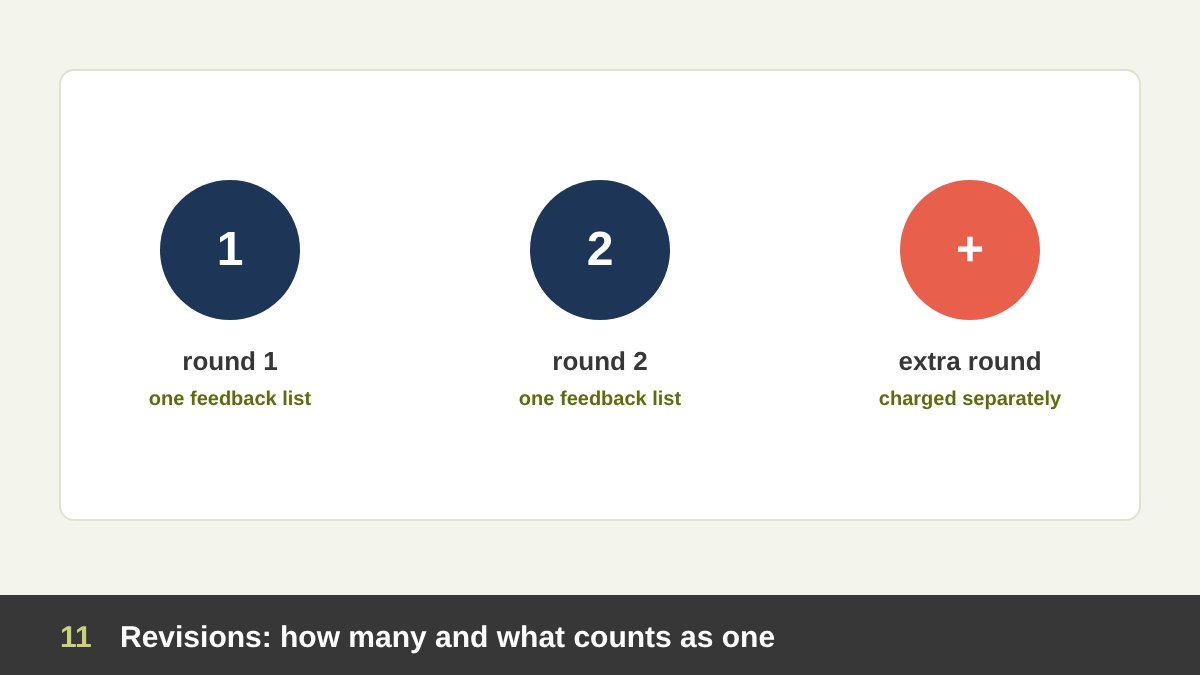
Revisions are where many design budgets quietly disappear. Always state the number of revision rounds included, usually two or three, and define what a round is: one consolidated list of feedback from the client, answered by one updated version from the designer. Ten separate messages over a week are not one round.
Distinguish between revisions and changes of direction. Adjusting colours, sizes, wording or details within an approved concept is a revision. Abandoning the approved concept and asking for something completely new is a new phase of work, and it should be priced as one.
Extra rounds are charged at your hourly rate or a fixed price per round, stated in the quote. In my experience, clear revision rules do not make clients unhappy; they make them more focused. When people know they have two rounds, they gather their thoughts, involve the decision maker and give better feedback. Presenting the work well also reduces revisions, as I explain in how to present your design work.
Usage Rights and Licensing: The Hidden Part of the Price
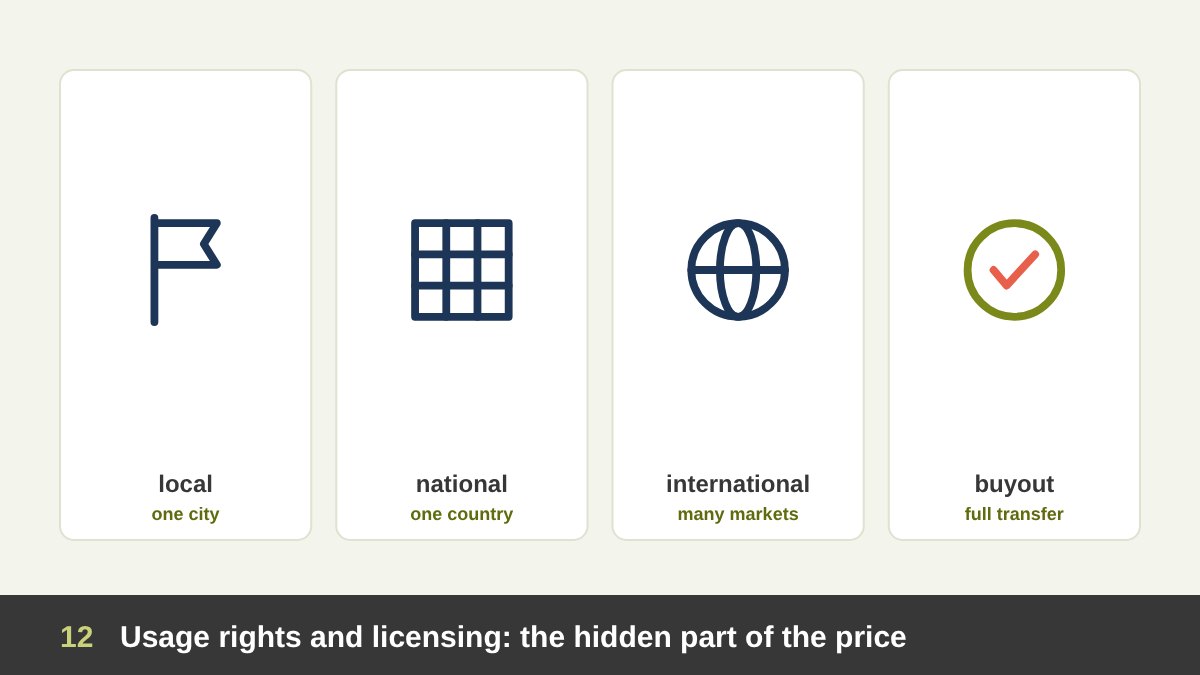
When a client pays for design, they are paying for the work and for the right to use it. In many fields, especially illustration, photography and advertising, the price depends heavily on usage: where the work will appear, for how long, in which countries and in what media. A drawing used once on social media is priced differently from the same drawing on national packaging for five years.
For logos and identities, clients normally expect full ownership of the final approved design, and that is fair; it should be stated clearly in the agreement, usually transferring rights after the final payment. Rejected concepts, working files and the designer’s right to show the work in their portfolio should also be addressed. For illustrations, templates or photography, licensing by usage is common and often more flexible for both sides.
Usage rules vary by country, so for large contracts it is wise to use a written agreement and, if needed, legal advice. The key point for pricing is simple: wider and longer usage justifies a higher price. Ask where and how the work will be used before you quote, not after.
Tiered Packages: Good, Better, Best
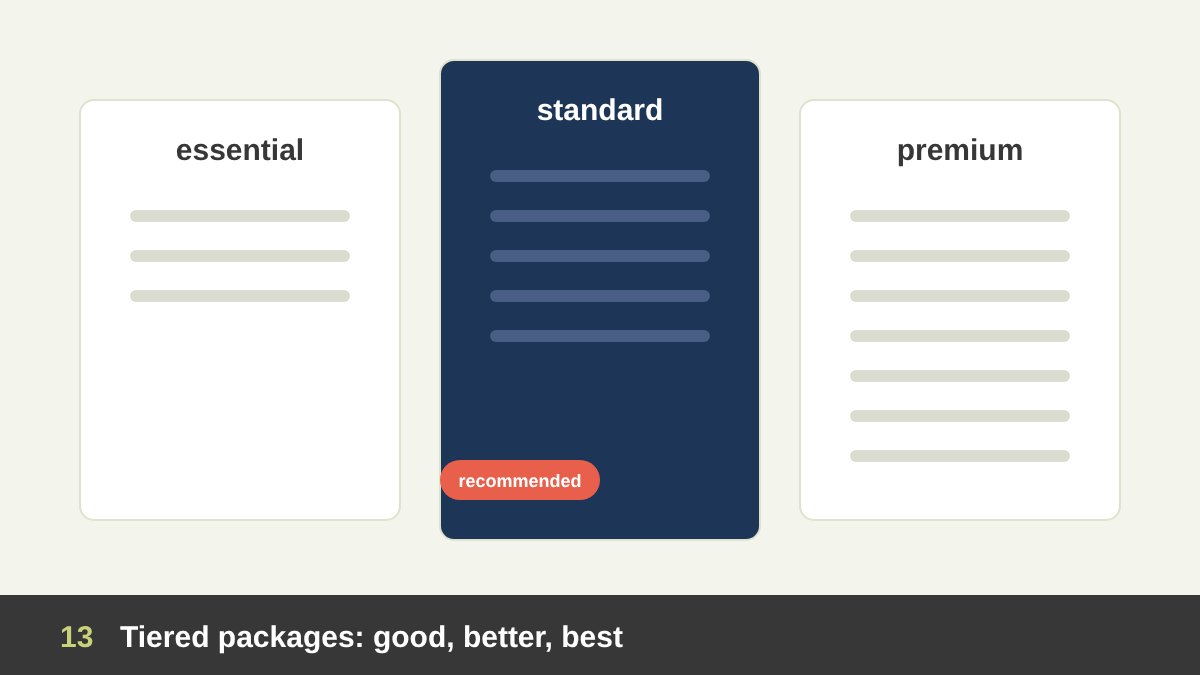
Instead of sending one price, you can offer three options: an essential package with the core deliverables, a standard package with more concepts or applications, and a premium package with the full system and extra support. For a logo, that might be a logo only, a logo with stationery and social templates, and a full identity with brand guidelines.
Packages change the client’s question from “should I hire this designer?” to “which option suits me?”. They also make value visible: the client can see what more investment brings. In my experience many clients choose the middle option, and some choose the premium one when they see it next to the others.
Keep packages simple: three options, clear differences, and no more than five or six lines in each. Each package must still be profitable on its own; the essential package is a smaller scope, not a discount. And remain flexible: packages are a starting point for the conversation, not a rigid menu.
Writing a Design Quote or Proposal That Gets Approved
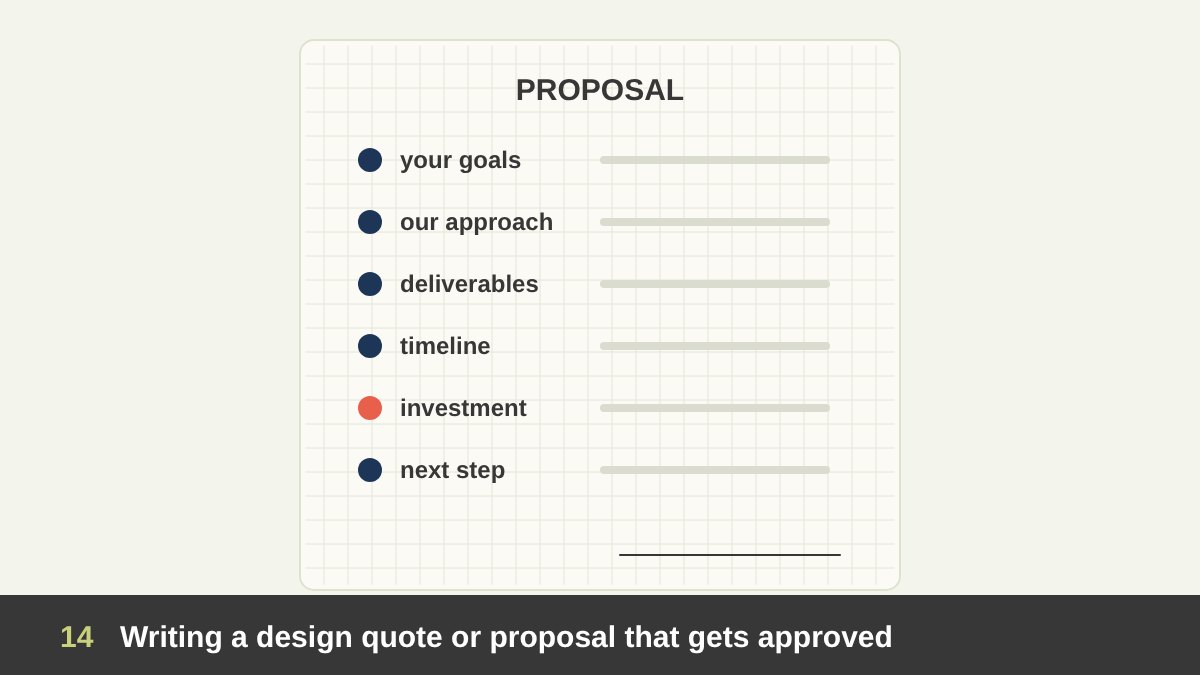
A quote should never be just a number in an email. A short proposal explains what you understood, how you will work and what the client receives. Start with the client’s goals in their own words, from the brief. Then describe your approach and phases, the deliverables, the timeline, the price and the terms, and finish with a clear next step, such as approving the proposal and paying the deposit.
Call the price an investment and connect it to the result. A proposal that says “Brand identity to help you win corporate clients: X” reads very differently from “Logo: X”. Keep the language simple and professional, avoid long design jargon, and make it easy to say yes.
Send the proposal quickly while the conversation is fresh, ideally within two or three days of the briefing meeting, and offer to walk the client through it in a short call. Many proposals are lost not because of the price but because they arrive late, look unprofessional or leave the client unsure about what happens next.
Payment Terms: Deposits, Milestones and Late Payments
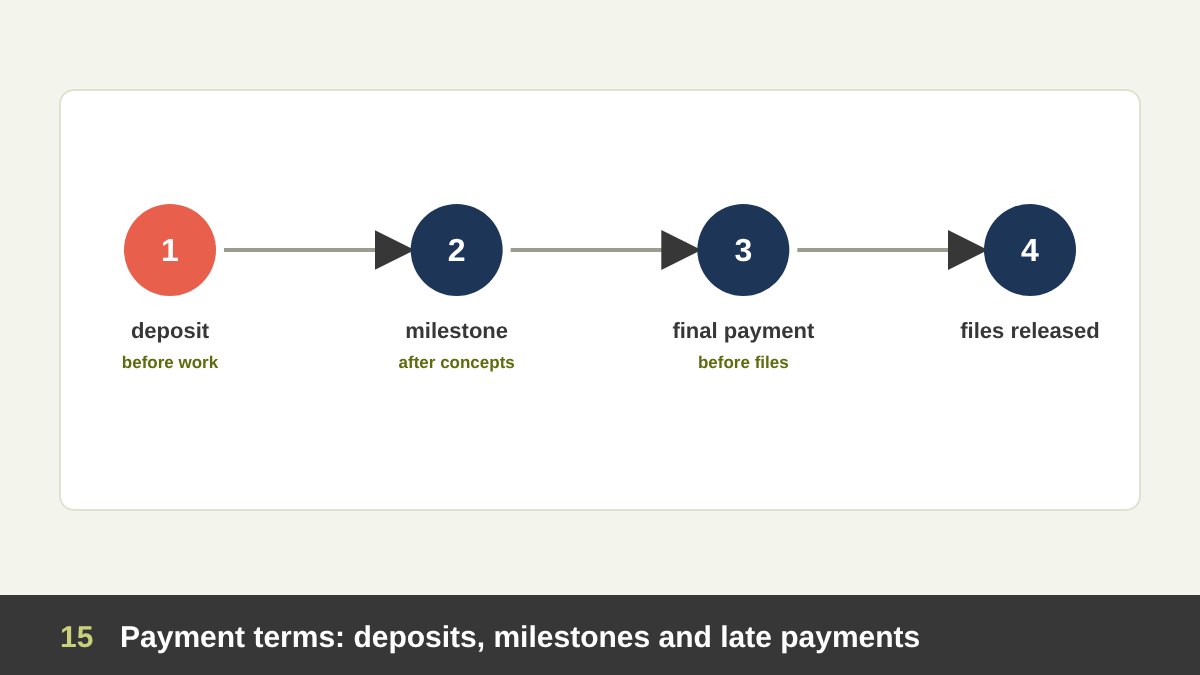
Clear payment terms protect your time and your cash flow. The most common approach is a deposit before work starts, often 30 to 50 percent, with the rest paid on delivery. For larger or longer projects, split the payments into milestones: a deposit, a payment after concepts are approved, and a final payment before final files are released.
State in the proposal when invoices are due, which payment methods you accept, the currency, and what happens if payment is late. A common professional rule is that final files and usage rights are transferred after the final payment. This is not about distrust; it simply keeps both sides committed until the end.
Do not start work without a deposit, especially with new clients. A deposit confirms that the client is serious and has budget. If a client refuses any deposit or delays it repeatedly, treat it as a warning. Payment terms, like scope, are much easier to agree at the start than to negotiate when there is a problem.
Pricing for Local and International Clients
Design prices vary greatly between countries, cities and industries. A designer in Cairo working for local small businesses, and the same designer working for a company in the Gulf or Europe, will meet very different budgets and expectations. This is normal; markets are different. What matters is that each price is still above your minimum and fits the value of the work for that client.
When working internationally, decide in which currency you quote, how exchange rates and transfer fees are handled, and which time zone affects meetings and deadlines. Quoting in a stable currency for international clients can protect you from fluctuations. Be clear about taxes and who pays transfer fees.
Do not lower your prices just because you live in a lower-cost country. International clients usually choose a designer for quality, reliability and communication, not for being the cheapest. A strong portfolio, clear English, fast replies and a professional process are worth more than a low price. Bilingual skills, such as Arabic and English design, can also be a real advantage in regional work.
When and How to Raise Your Prices
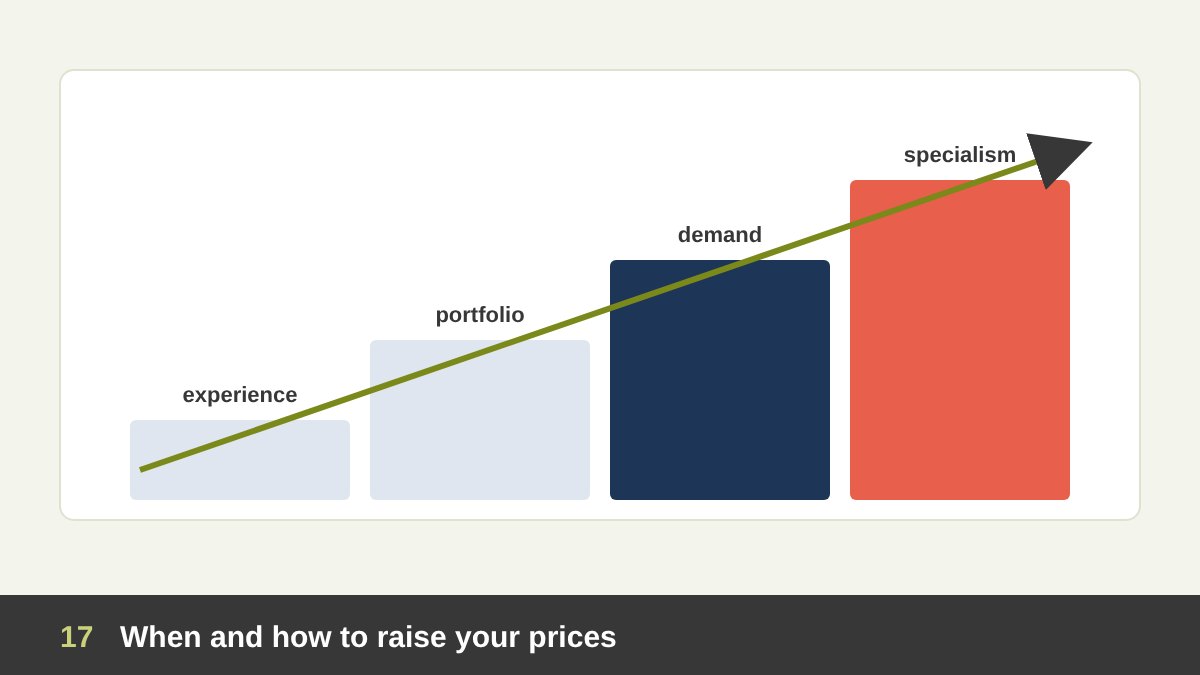
Your prices should grow with your experience, your portfolio and your demand. Clear signs that it is time to raise your prices: you are booked for weeks ahead, most clients accept your quotes immediately, your work and results have improved, you have specialised in a field, or your costs have increased. If nearly every client says yes without hesitation, you are probably too cheap.
For new clients, simply quote the new price; they do not know the old one. For existing clients, give advance notice, for example one to three months, explain briefly that your rates are being updated, and thank them for their trust. Most good clients understand. Some may leave, and that often opens space for better-paying work.
Raising prices is easier when you can show value: case studies with real results, a clearer process, faster communication, and specialisation in a field such as identity design or presentations. A portfolio of well-documented projects, like the case studies in my branding portfolio, is one of the strongest arguments for a higher price.
Discounts, Free Work and Spec Work
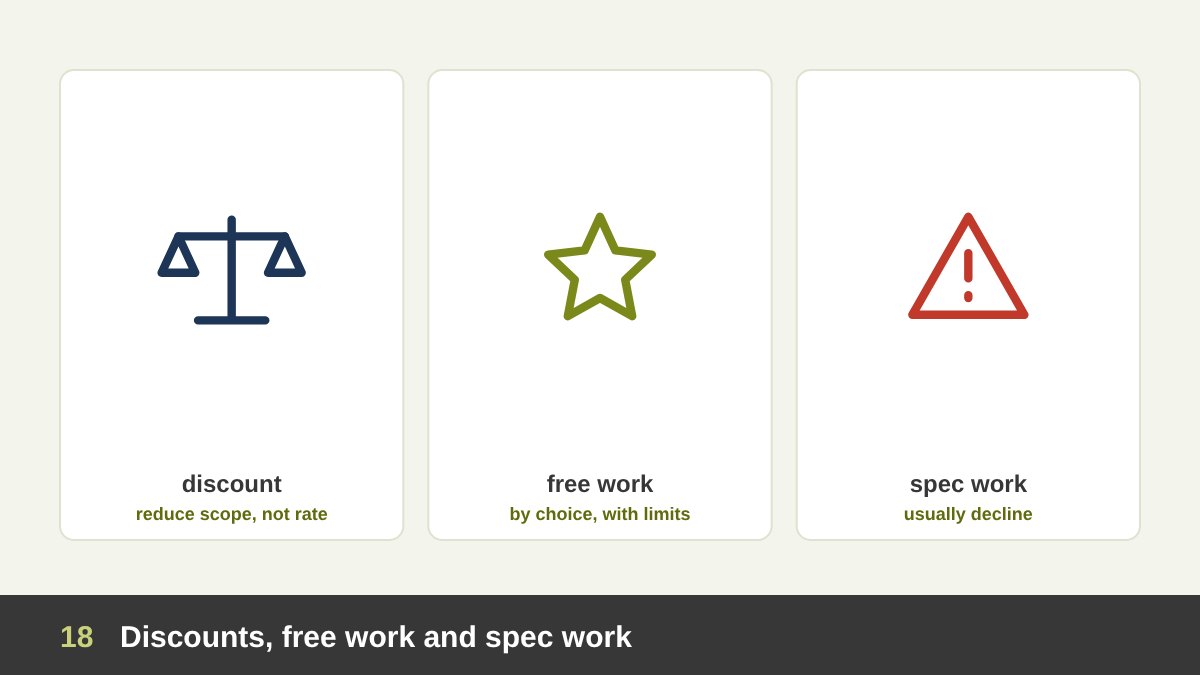
Discounts are not forbidden, but they should be deliberate. Instead of reducing the price for the same work, reduce the scope: fewer concepts, fewer applications, a simpler deliverable. This keeps your rate intact and shows the client that price and scope are connected. If you give a discount, show it clearly on the invoice so the full value remains visible.
Free work can sometimes make sense: a cause you believe in, a project that opens a new field for your portfolio, or helping a friend. Decide consciously, set a clear limit, and treat it as a professional project with a brief and a deadline. Free work without boundaries quickly becomes unpaid work without respect.
Spec work, meaning designing concepts for free in the hope of being chosen, is different. It asks designers to give away their most valuable part, the thinking, without any commitment. I generally decline it and instead offer a paid discovery phase or show relevant past work. You can read my wider view on this in when to say no as a designer.
Common Pricing Mistakes Designers Make
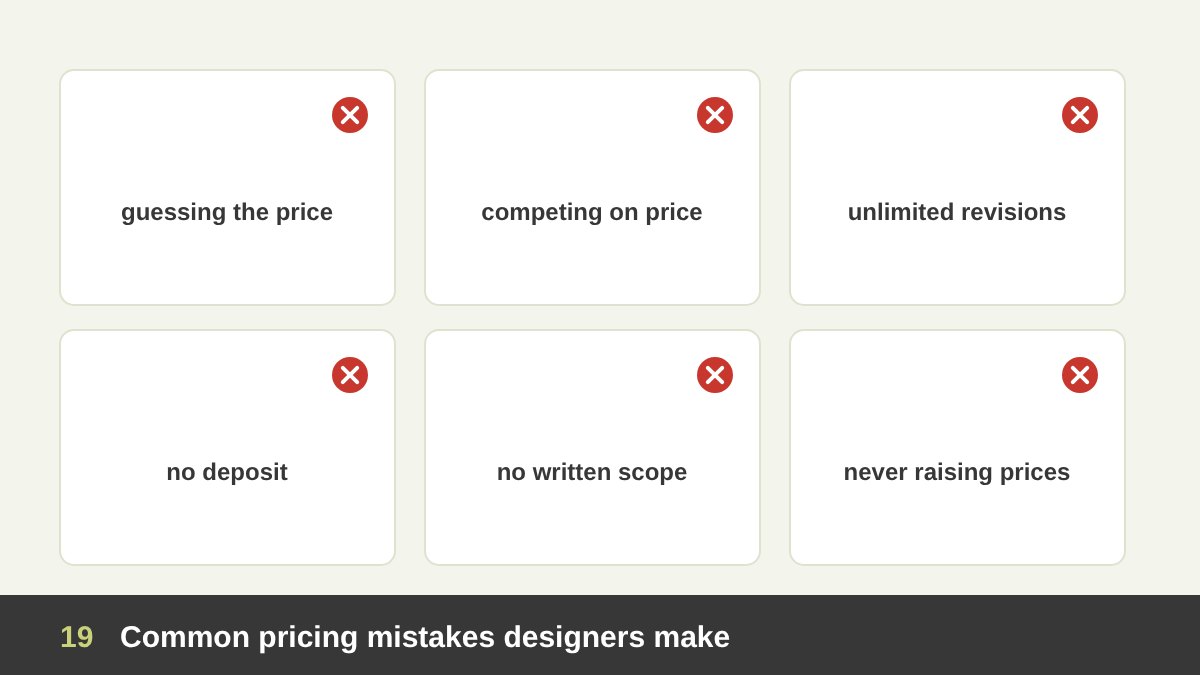
The most common mistake is guessing: picking a number because it feels right or because another designer charges it, without knowing your costs and billable hours. The second is competing on price: there will always be someone cheaper, and clients who choose only on price are rarely loyal or easy to work with.
Other frequent mistakes: unlimited revisions, no written scope, no deposit, forgetting to price usage rights, lowering the price immediately when the client hesitates instead of adjusting the scope, sending a quote without explaining the value, and underestimating communication and project management time.
And finally, never raising prices. Many designers keep the same rates for years while their skills, costs and experience grow. Review your numbers at least once a year. Pricing is not a one-time decision; it is part of running a design practice as a real business.
Design Pricing Checklist: Before You Send a Quote
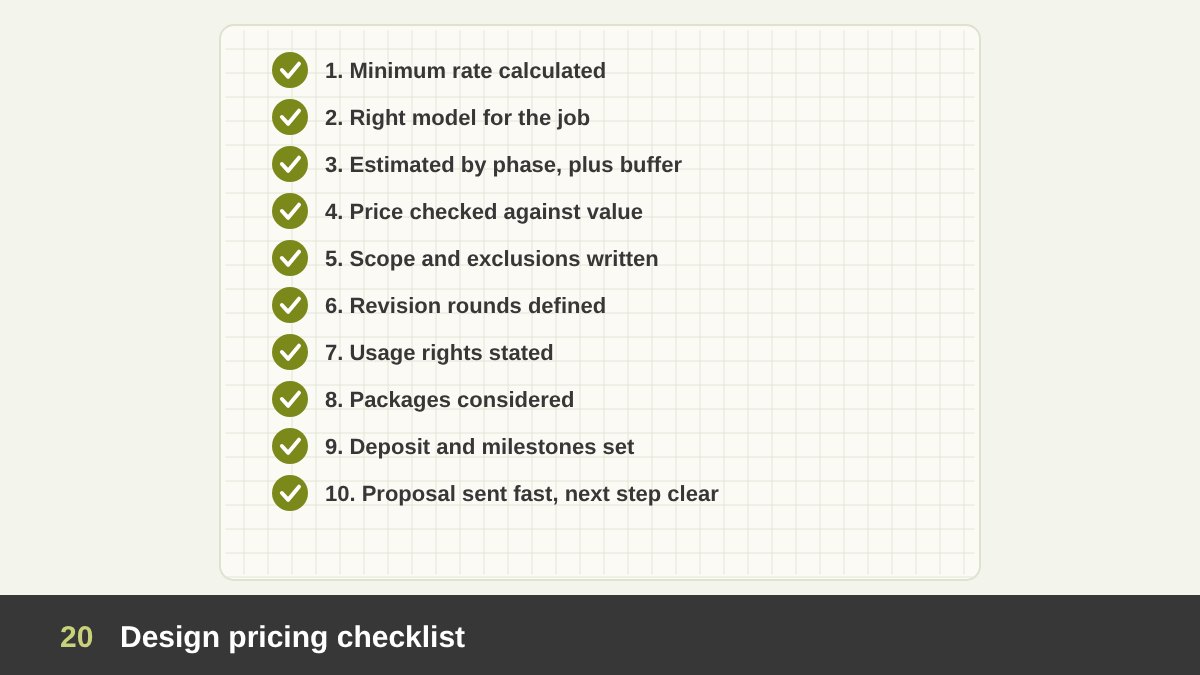
Before you send any quote, check the essentials. Do you know your minimum rate, based on costs, target income and realistic billable hours? Have you chosen the right model for this project: hourly, project, value-based or a retainer? Have you estimated by phase and added a buffer? Does the final price respect your minimum and reflect the value of the work?
Is the scope written clearly, including what is not included? Are the revision rounds defined? Are the usage rights stated? Have you considered offering packages? Are the payment terms, deposit and milestones clear? And is the proposal sent quickly, with a simple next step?
Good pricing is not about being expensive or cheap; it is about being clear, fair and sustainable, so you can keep doing your best work for clients who value it. If you are planning a branding or design project and would like a clear proposal, you can get in touch.
How to Price Design Work: Frequently Asked Questions
How do I calculate my hourly rate as a designer?
To calculate your hourly rate as a designer, add your yearly business costs, such as equipment, software, workspace and taxes, to the yearly income you need. Divide the total by your realistic billable hours per year, which are usually much fewer than your working hours because of admin, meetings and marketing. The result is your minimum hourly rate; your actual prices should be at or above it.
Should designers charge hourly or per project?
Designers should usually charge per project for work with a clear scope and defined deliverables, such as logos, identities, websites and print, because the client knows the total and the designer is rewarded for efficiency. Hourly pricing is better for small edits, consulting and projects with an unclear or changing scope. Many designers use both, depending on the job.
What is value-based pricing in design?
Value-based pricing in design means setting the price according to the value the design creates for the client, rather than the hours it takes. A brand identity for a company launching nationally is worth more than the same effort for a small local shop. It requires understanding the client’s goals, the expected impact and how long and widely the design will be used.
How many revisions should be included in a design project?
Most design projects include two or three revision rounds. A revision round should be defined as one consolidated set of client feedback answered by one updated version from the designer. Changes within an approved concept count as revisions; abandoning the concept and asking for a new direction is new work. Extra rounds should be priced in the quote.
Should I ask for a deposit before starting design work?
Yes. Asking for a deposit before starting design work is standard professional practice. Many designers ask for 30 to 50 percent upfront, with the balance on delivery or split into milestone payments for larger projects. A deposit confirms the client’s commitment and budget, protects your time and reduces the risk of unpaid work.
When should a designer raise their prices?
A designer should raise their prices when they are consistently fully booked, when almost every client accepts their quotes without hesitation, when their skills, portfolio and results have improved, when they specialise, or when their costs increase. New clients can simply receive the new rates, while existing clients should get advance notice, usually one to three months.
Leave a Reply