

Why a Designer Needs Character, Not Only Talent
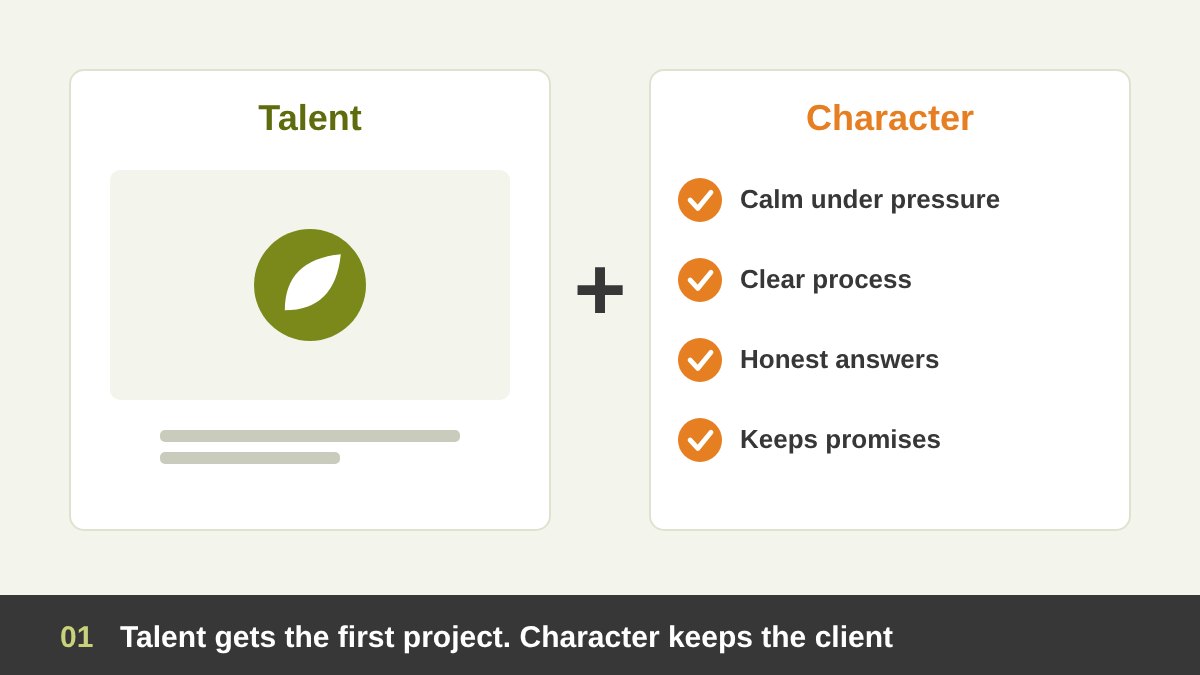
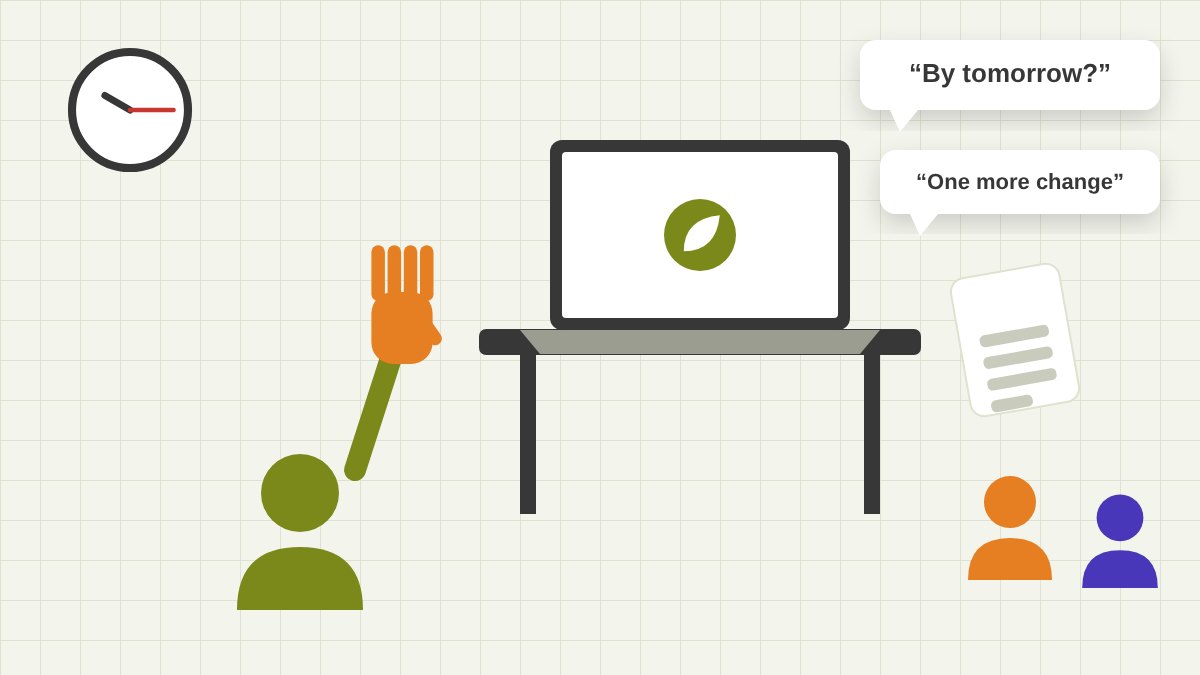
Design schools teach typography, colour, grids and software. Nobody teaches you what to do when a client calls on Thursday and wants the full identity by Sunday, or when your manager asks you to “make it look exactly like the competitor’s ad”. Yet these moments decide your reputation as much as your portfolio does. In many years as an art director, I have seen talented designers lose good clients because they could not say no, and average designers grow fast because they knew how to protect their work without fighting anyone.
This article is about that other side of the job: the professional character of the designer. We will look at when to push back, when to negotiate and when to say no as a designer, with real cases: rushed deadlines, endless “small changes”, free work, unreasonable requests from a manager, and requests that cross an ethical line. Most importantly, we will look at how to say it, so you protect your process and your relationships at the same time. Here is the short version:
Key takeaways
- Talent gets you the first project. Professional character (how you handle pressure, conflict and bad requests) decides whether clients and managers trust you with the next one.
- You cannot defend a process you cannot explain. Write your process down, with the time each step really needs, before you ever need to defend it.
- Most requests are not a choice between yes and no. The best answer is often “yes, if…”: a trade between time, scope, quality and cost.
- Say a clear no to anything unethical or illegal: copying other people’s work, unlicensed fonts and images, or misleading claims.
- Disagree with the idea, never with the person. Use questions, options and written agreements, and let a good contract say no for you.
You Cannot Defend a Process You Cannot Explain
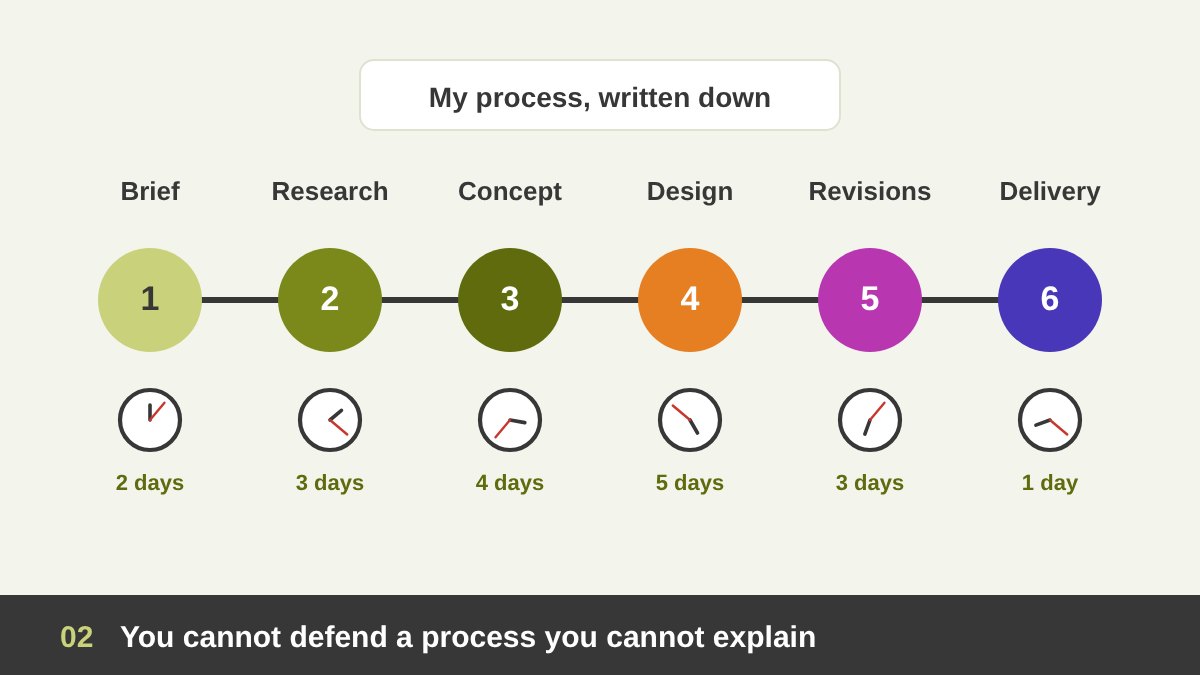
Before you can push back on anything, you need something solid to stand on, and that is your process. Many designers work by instinct: they receive a request, open the software and start. When a client asks “Why do you need two weeks for a logo?”, they have no clear answer, so they either give in or get defensive. Both are bad. A designer who can say “Here is my process, here is what happens in each step, and here is why skipping it hurts your result” sounds like an expert, not like someone making excuses.
So write your process down. For each service you offer, list the steps (brief, research, concepts, design, revisions, final files) and the real time each step needs, including your thinking time. Decide how many revision rounds are included, what counts as a new request, and what you need from the client at each stage. Put this in your proposals and explain it in the first meeting. When the process is shared from day one, you rarely need to defend it later, because the client already agreed to it. If you want to understand why steps like research and concept matter so much, read my guide to good logo design.
Yes, “Yes, If…” or No: A Simple Way to Decide
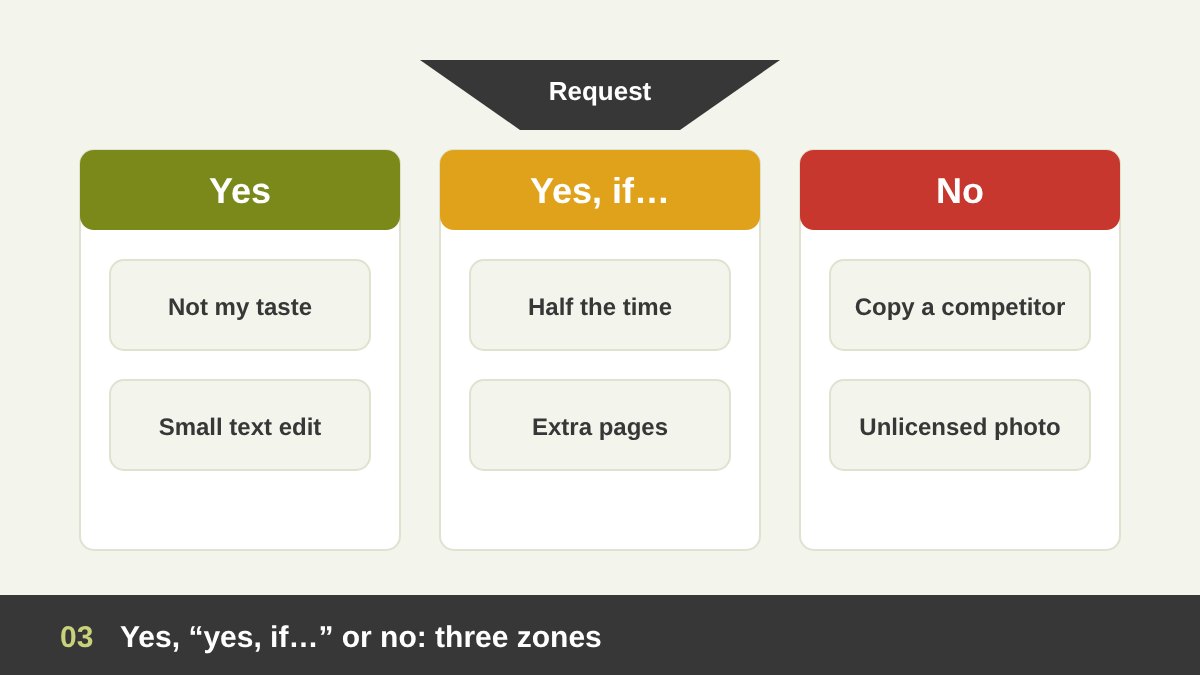
Not every bad request deserves a fight, and not every request deserves a yes. Before you answer, ask yourself three quick questions. First: Does this hurt the result? Will the design work worse for the client’s goal? Second: Does this hurt the client or the people who will use the design? Third: Is it unethical, illegal, or against my agreement? Your answers place the request in one of three zones.
If the answers are all no, it is a green request: maybe not your personal taste, but harmless. Say yes and do it well; you do not need to win every small battle. If the request hurts the result, the timeline or your agreement, it is an amber request: do not refuse it, negotiate it. Explain the cost and offer options (“yes, if we…”). If it is unethical, illegal or harmful, it is a red request: say no, clearly and calmly, and offer an honest alternative. Most of your daily work will be green and amber. Red is rare, but when it comes, you must recognise it.
When the Client Wants It in Half the Time
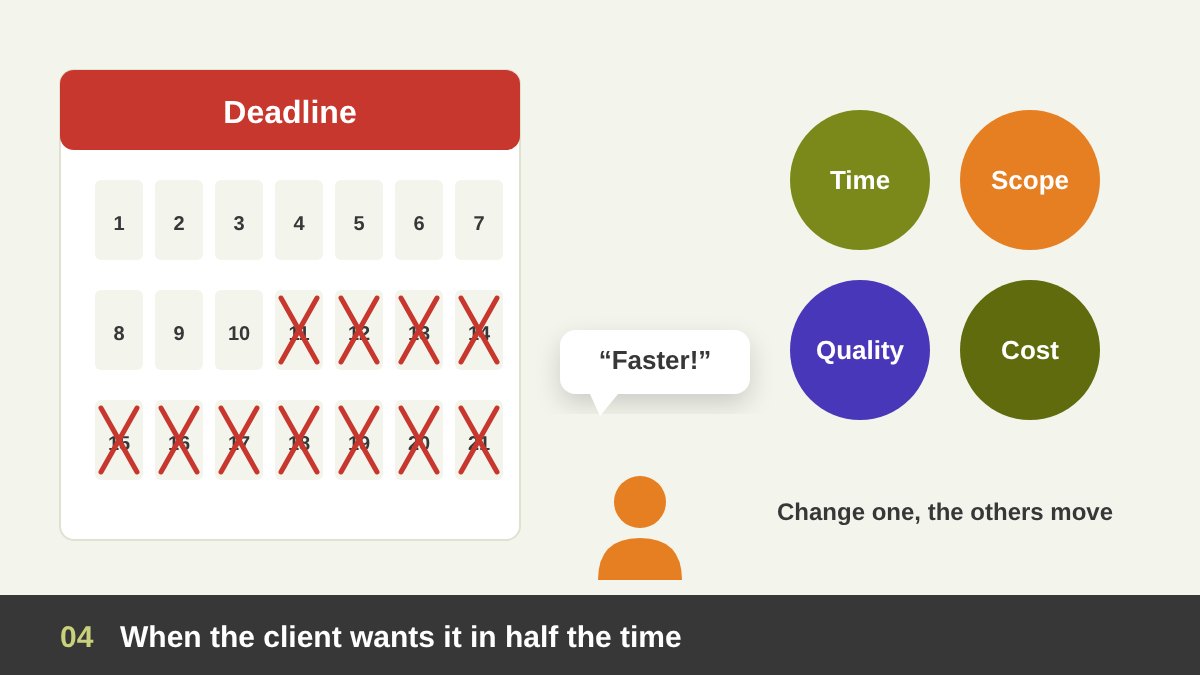
This is the most common situation of all. The proper timeline is three weeks, and the client wants it in one. The worst answer is a silent yes: you accept, work all night, skip research and deliver something weaker than you can do. The client will not remember that you were rushed. They will only remember that the work was average. The second worst answer is a flat no, which closes the door on a client who may have a real reason for the deadline, like an exhibition, a launch or an investor meeting.
The professional answer starts with a question: “What is happening on that date?” Once you understand the real deadline, you can offer options, because time is always connected to scope, quality and cost. You can deliver the most important part first (the logo for the event) and the rest later (the full guidelines). You can reduce the scope, with fewer concepts or fewer applications. You can add a rush fee that pays for the extra hours and the other work you will move. What you should not offer is the same scope, at the same price, in half the time, with lower quality. Put the option the client chooses in writing, so nobody forgets later that the timeline was their choice.
“Just One Small Change”: Endless Revisions and Scope Creep
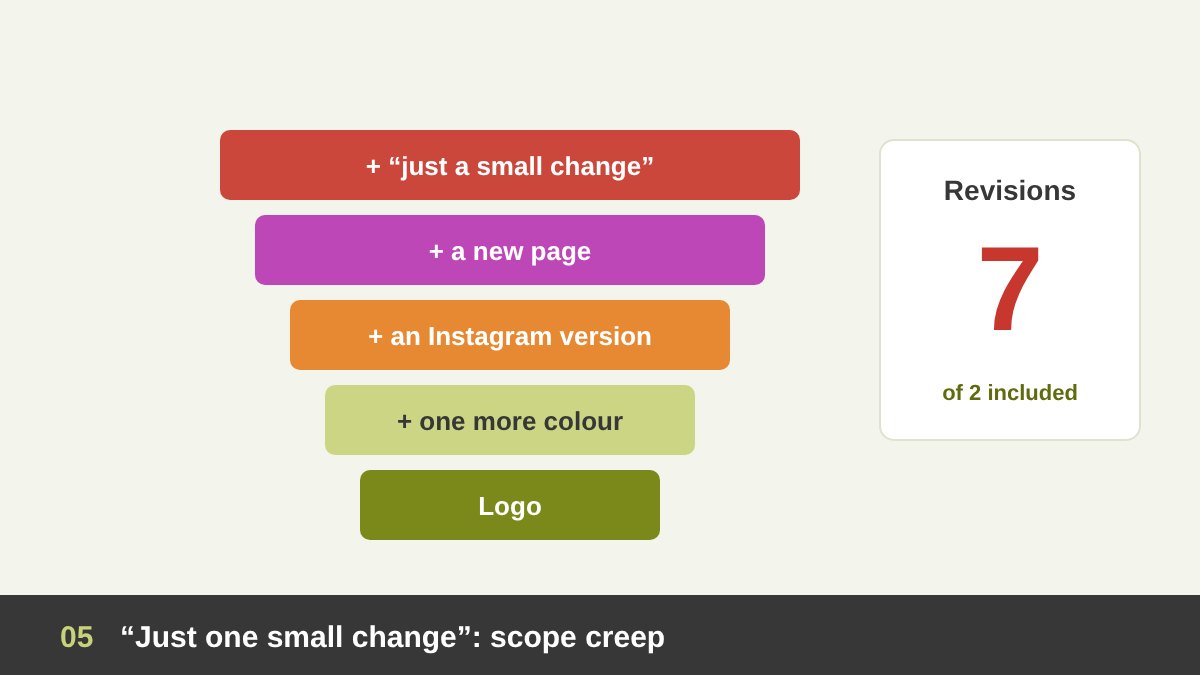
Every designer knows the sentence: “It’s just a small change.” Then another one, then a new page, then a version for Instagram, then the logo “in a few more colours to choose from”. Each request alone looks small, but together they can double the project, and this is called scope creep. The problem is not the client; most clients simply do not know how much work a change takes. The problem is a project with no clear limits.
The solution is to set the limits before the work starts and to refer to them kindly when they are reached. Define in your proposal how many concepts and how many revision rounds are included, and what counts as a revision versus a new request. When an extra request arrives, do not complain and do not quietly do it for free. Say: “Happy to do that. It is outside the current scope, so here is the time and cost for it.” Group small changes into one round instead of answering each message alone. Clients respect a designer who tracks the project clearly far more than one who says yes to everything and then gets frustrated.
Free Work, Spec Work and “It’s Only a Quick Logo”
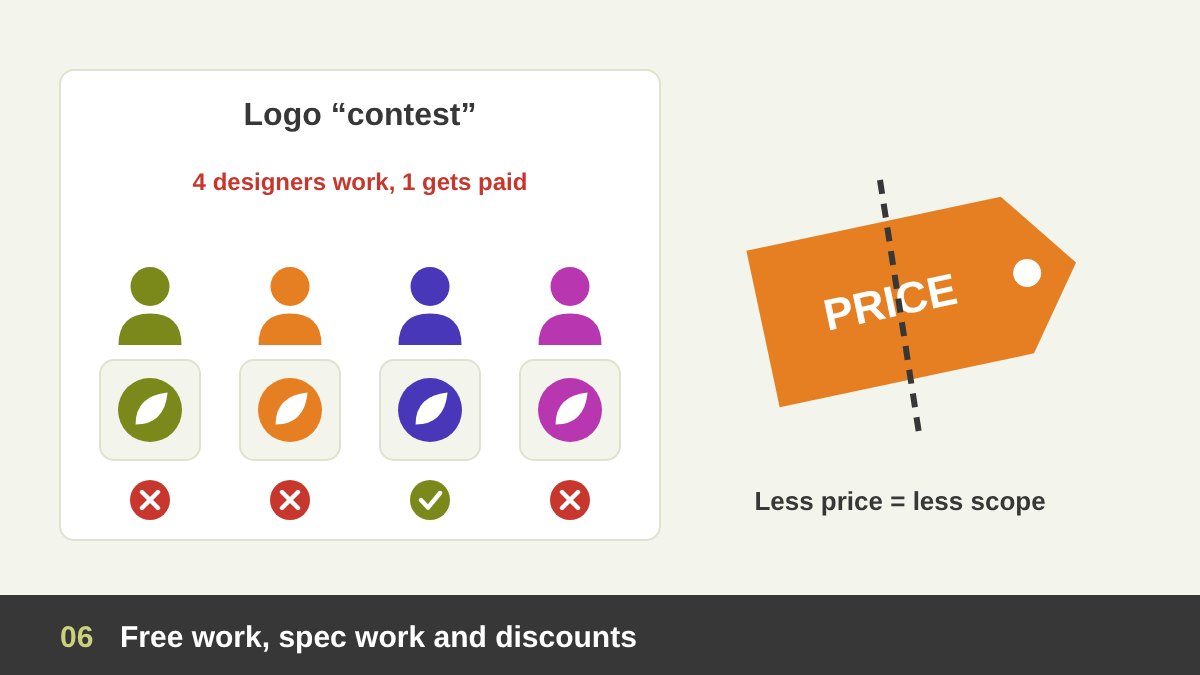
Some requests are not about time but about value. “Can you do a few logo ideas first, and we pay if we like one?” This is spec work: working for free in the hope of being paid. It treats your thinking as worthless until it is chosen, and it usually leads to rushed, shallow ideas because the client has not paid for research. A polite no is the right answer here. Offer a paid small first phase instead, such as a discovery session or one concept direction, or show relevant past projects from your portfolio as proof of your level.
Discounts need the same calm thinking. If a client cannot afford your full price, do not simply cut the price and keep the full scope, because you teach them that your price was never real. Reduce the scope with the price: a logo without the full guidelines, or a smaller website first. Free work is not always wrong: helping a charity you believe in, or a project that builds your portfolio in a new field, can be a good choice. The difference is that you decide it, with clear limits, instead of being pushed into it. I wrote more about pricing and working with clients in my article on freelance graphic designer skills.
When Your Manager Asks for Something That Does Not Make Sense
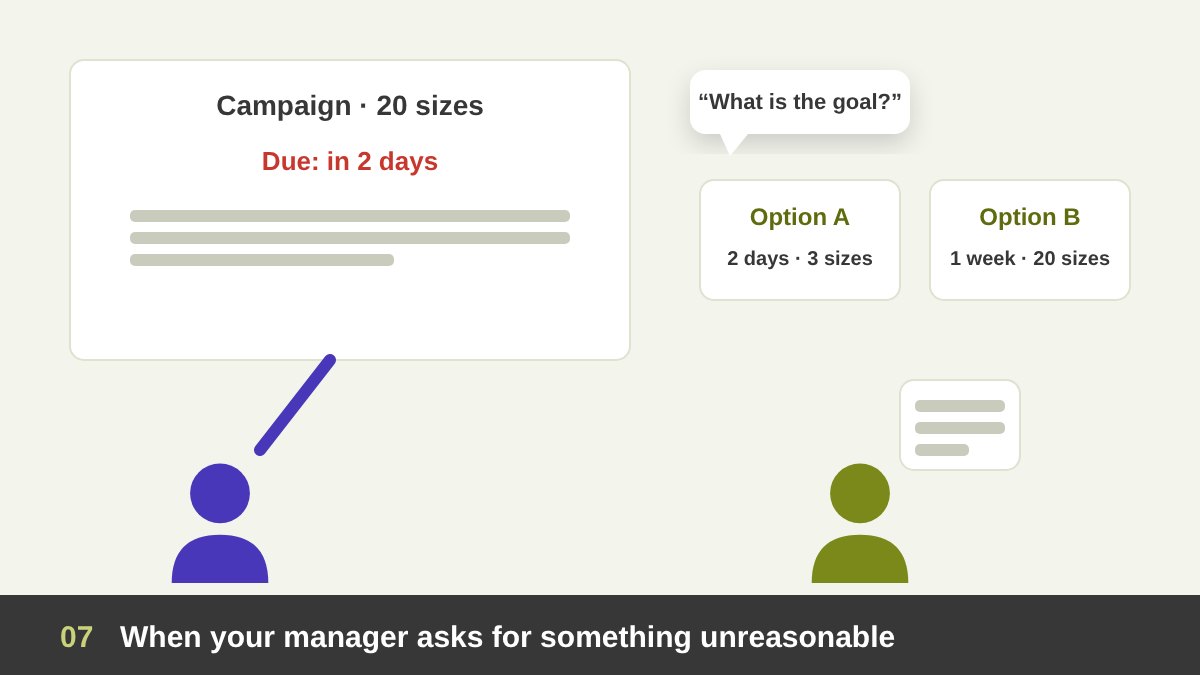
Working inside a company is different from freelancing. You cannot simply raise a price or walk away from a request; your manager has authority, and they see business pressures you may not see. So when a manager asks for something that seems unreasonable, such as a full campaign in two days, a design that breaks the brand guidelines, or copying a competitor’s style, start with curiosity, not resistance. Ask: “What is the goal behind this? What happens if we do it differently?” Often the request makes more sense once you know that the CEO promised something to a partner, or that a sales team needs material for a meeting.
Then answer with options, not with complaints. “In two days I can deliver the main visual and three sizes. The full set of twenty sizes needs a week. Which is more important for Thursday?” This shows you are solving the manager’s problem, not refusing it. If a request clearly breaks the brand or will hurt the company, explain the risk briefly and in writing, ideally with an example. If the manager still decides to go ahead, follow the rule of disagree and commit: you said your opinion professionally, the decision is theirs, and now you do your best work on it. That is not weakness. It is how trust is built, and trusted designers are the ones whose opinion is asked first next time. I describe this relationship from the manager’s side in the art of managing graphic design.
When the Request Hurts the Design Itself
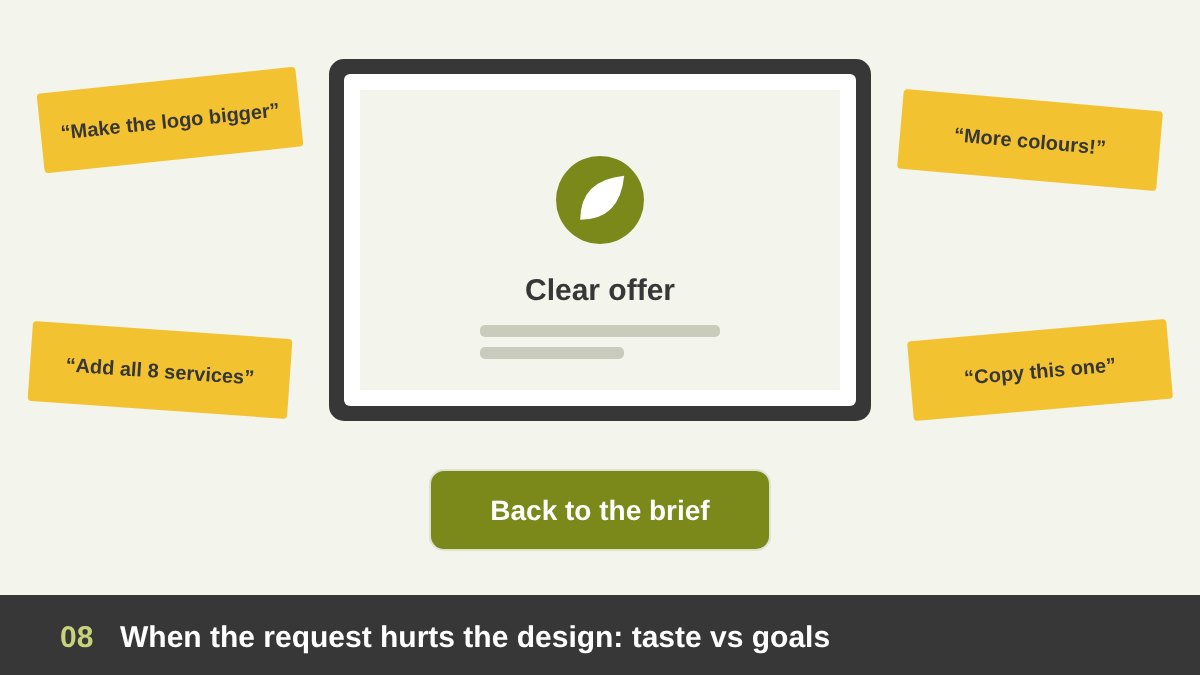
“Make the logo bigger.” “Add more colours, it looks empty.” “Can you put all the services on the cover?” These requests are not unethical; they are simply harmful to the result. Here your job is to move the conversation from taste to goals. Do not answer “That will look bad”, because that is your taste against theirs. Answer with the brief: “Our goal is that customers read the offer in two seconds. If we add all eight services, nobody will read any of them. Can we choose the two most important?”
When words are not enough, show. Prepare the requested version next to your recommended version, side by side, and let the client compare. Very often they choose the better one themselves, and if they do not, at least the decision is informed. Choose your battles: if the change is small and does not damage the main goal, accept it with a smile and save your energy for what really matters. A designer who fights every comment is tiring to work with; a designer who fights only for the important points is listened to. Explaining your design decisions clearly from the first presentation prevents most of these conversations, as I explain in how to present your design work.
Red Lines: Requests Every Designer Should Refuse
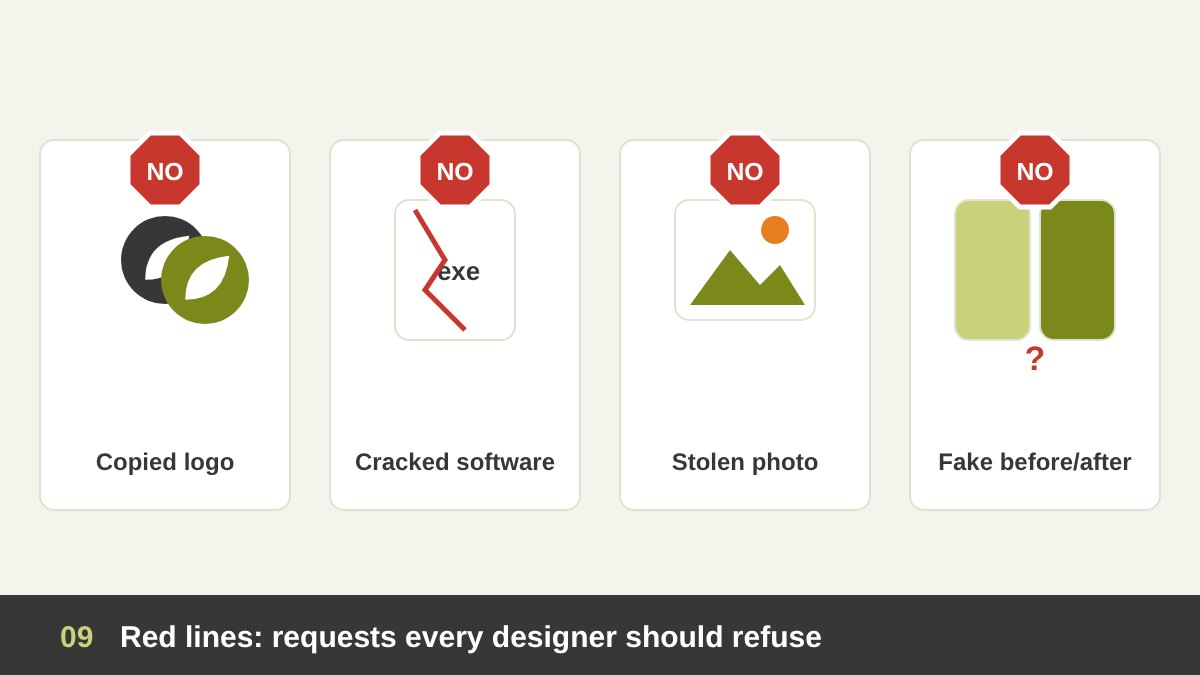
Some requests are not about quality or time. They are simply wrong, and here a clear no is part of your professionalism. Refuse to copy another designer’s or brand’s work, even “with small changes”; it is unfair to the original creator and it can bring legal trouble to the client. Refuse to use unlicensed fonts, photos, illustrations or cracked software in commercial work. Refuse to create designs that mislead people, such as fake reviews, false health claims or before-and-after images that are not real. And be careful with AI-generated images that imitate a living artist’s style or a protected brand, a topic I discuss in AI and Adobe for graphic designers.
Saying no here does not need anger or a lecture. Keep it short, factual and helpful: “I can’t use this photo without a licence, because it can lead to a copyright claim against your company. Here are three similar licensed options.” Or: “I won’t copy their logo, but I can design something that gives the same feeling of trust and is fully yours.” You protect the client from a risk they may not see, and most clients thank you for it later. If a client insists on something illegal or harmful, that is a project worth losing.
How to Say No Without Burning the Bridge
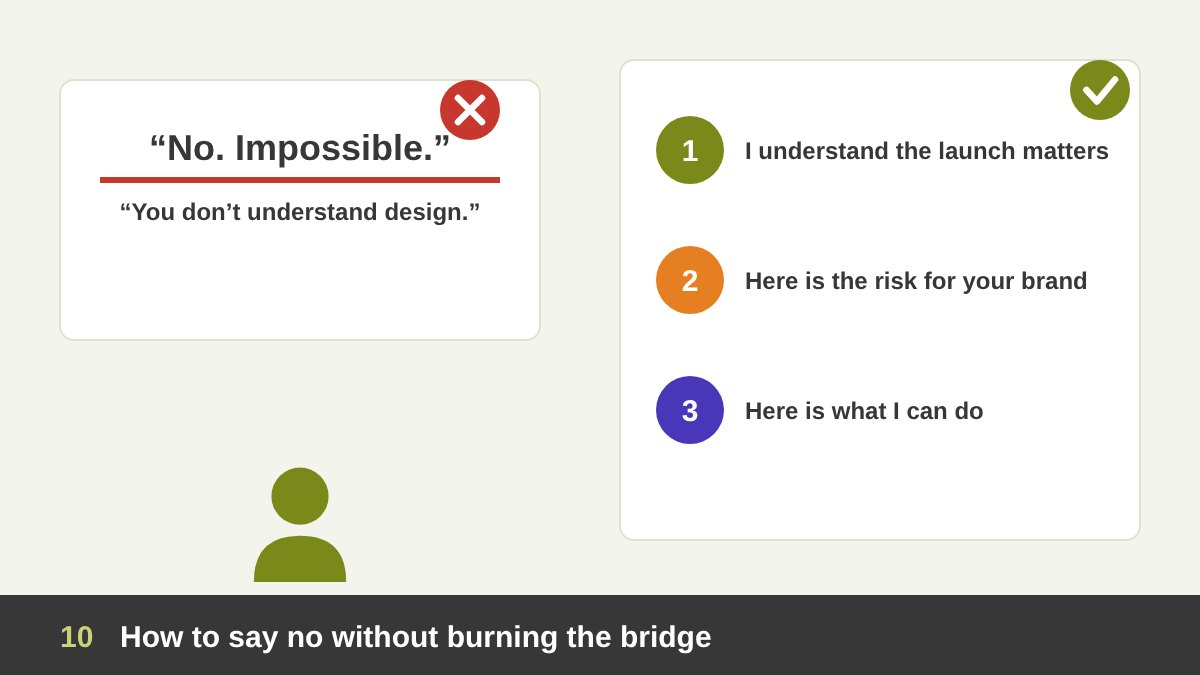
The difference between a designer who is “difficult” and one who is “professional” is rarely the decision. It is the way the decision is said. A good no usually has three parts. First, show that you understand the need: “I know the launch date is important for you.” Second, give the reason, connected to the client’s interest, not your comfort: “If we skip the research, we risk a logo that looks like your competitors.” Third, offer an option: “What I can do is deliver the logo by Thursday and the full guidelines next week.”
Watch your tone and your channel. Difficult answers are better in a call or a meeting than in a short chat message, where tone is easily misunderstood; then confirm the result in writing. Do not answer when you are angry; wait an hour. Avoid words like “impossible”, “that’s wrong” or “you don’t understand design”. Replace “no” with “here is what I can do”. And keep your promises: if you said Thursday, deliver on Thursday. Every promise you keep makes your next no easier to accept, because people know your no is never laziness. The table below gives ready answers for the most common situations.
| Situation | Zone | What to say | What to avoid |
|---|---|---|---|
| Client wants the project in half the time | Amber: negotiate | “What happens on that date? I can deliver the logo first and the guidelines a week later, or keep the full scope with a rush fee.” | A silent yes, then rushed and weaker work |
| “Just one more small change” again and again | Amber: negotiate | “Happy to do it. It is outside the agreed scope, so here is the time and cost.” | Doing everything for free, then complaining |
| Free concepts before any payment (spec work) | Red: polite no | “I don’t do free concepts, but we can start with a paid discovery session, and here is similar work I did.” | Sending ideas for free and hoping |
| Lower price for the same work | Amber: negotiate | “We can fit your budget by reducing the scope: the logo now and the guidelines later.” | Cutting the price and keeping the full scope |
| Manager wants a full campaign in two days | Amber: negotiate | “In two days I can deliver the main visual and three sizes. Which is more important for Thursday?” | Refusing in front of the team, or burning out quietly |
| “Make it look exactly like the competitor” | Red: polite no | “I won’t copy them, but I can give you the same feeling of trust in a design that is fully yours.” | Copying with “small changes” |
| “Make the logo bigger” or “add more colours” | Green or amber | “Our goal is a clear message in two seconds. Here are both versions side by side.” | “That will look bad” (taste against taste) |
| Using an image or font found online | Red: polite no | “It needs a licence, or the company risks a claim. Here are licensed options.” | Using it and hoping nobody notices |
Put It in Writing: Systems That Say No for You
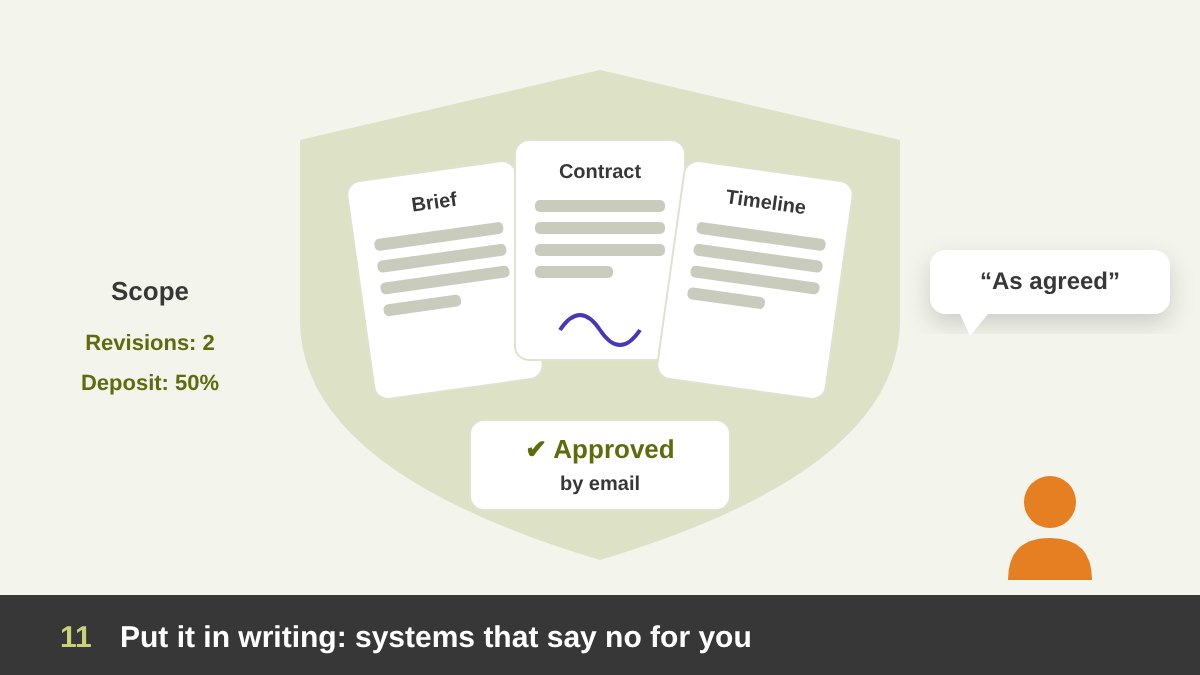
The strongest designers do not argue more; they argue less, because their systems say no for them. A written brief that the client approved answers the question “Why did you design it this way?”. A proposal that lists the scope, the revision rounds and the timeline answers “Can you add just one more thing?”. A payment schedule, for example a deposit before starting and the final files after the last payment, answers the client who disappears after approval. When the rule is written, you are not refusing; you are simply following what both sides agreed.
Inside a company, the same idea applies with different tools: a request form or brief template, a shared task board, clear lead times for each type of work (“social posts need two working days, a campaign needs two weeks”), and written approvals from the right person. Agree on these with your manager when things are calm, not in the middle of a crisis. Then, when an urgent request arrives, you are not saying no to your manager; you are asking which of the current tasks should move, so the system stays fair for everyone.
Building the Character: Confidence, Calm and Choosing Your Battles
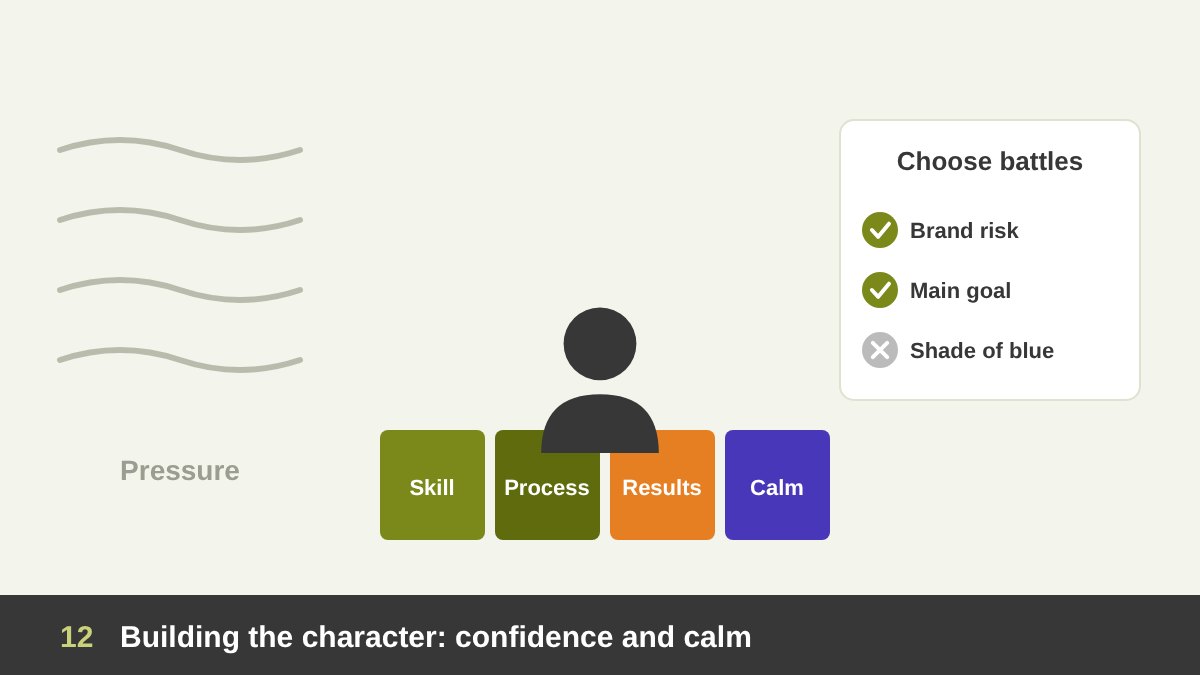
The ability to say no is not a personality you are born with; it is built. It starts with competence: the better you know your craft, the easier it is to defend your choices, because you are not guessing. It grows with results: every project that succeeded because you protected the process gives you a story you can tell the next client. Keep notes of these stories. “Last time we skipped testing, we reprinted 5,000 brochures” is more convincing than any theory.
Character also means emotional control. Pressure, criticism and last-minute changes are part of the job, not a personal attack. Separate your work from your ego: a client rejecting a concept is not rejecting you. Choose your battles; not every comment deserves resistance. Admit your own mistakes quickly, because a designer who says “You are right, I missed that” is believed when they say “I don’t recommend this”. Over time, people stop seeing you as the person who makes the designs and start seeing you as the person who protects the result. That is when you move from designer to trusted partner, and it is the real difference between many of the graphic design job titles you see in the market.
When to Walk Away, and How to Do It Professionally
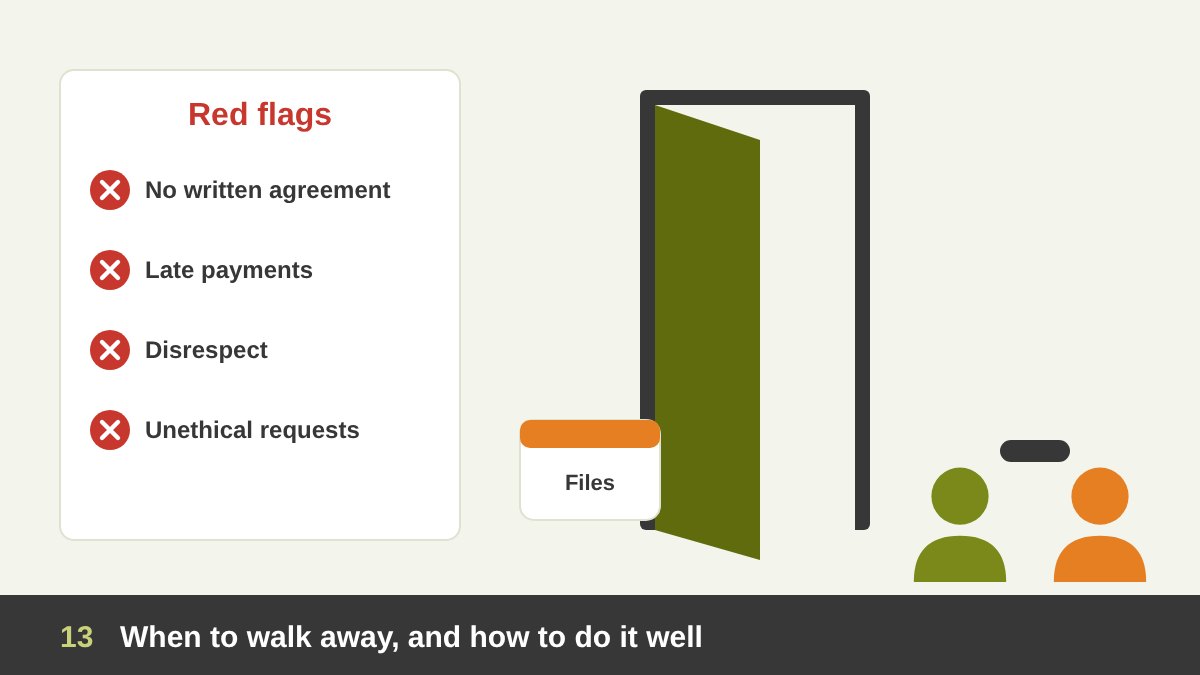
Sometimes the right no is to the whole relationship. Watch for red flags: a client who refuses any written agreement, delays payments again and again, disrespects you or your team, asks for unethical work, or changes the direction completely every week and blames you for the delay. One bad sign can be a misunderstanding. A pattern is a warning. Before you walk away, have one honest conversation about what is not working; many problems are solved there.
If it does not improve, end it professionally. Finish or hand over the work that was paid for, send the files you agreed on, close the account in writing and keep your tone polite. Never speak badly about the client in public. The design community and the market are smaller than you think, and the way you leave is remembered as much as the way you worked. Saying no to the wrong client makes room for the right one. If you are looking for a designer who will respect your deadline, tell you the truth about your design and protect your brand, get in touch with me.
Saying No as a Designer: Frequently Asked Questions
When should a designer say no to a client?
Say no when a request is unethical or illegal, such as copying other work, using unlicensed material or misleading people, or when it would clearly harm the result and the client refuses every alternative. For most other requests, negotiate instead of refusing: explain the cost and offer options.
How do I say no to a client politely?
Show that you understand their need, explain the reason in terms of their goal, and offer an alternative you can deliver. Have difficult conversations by call or in a meeting, then confirm the outcome in writing.
What should I do when a client wants a design faster than my process allows?
Ask what the deadline is for, then offer options: deliver the most important part first, reduce the scope, or add a rush fee. Avoid accepting the same scope and price in half the time with lower quality, and write down the option the client chooses.
How can an in-house designer push back on an unreasonable manager request?
Start by asking about the goal behind the request, then answer with options and their trade-offs in time and quality. Explain serious risks briefly and in writing. If the manager still decides, respect the decision and do your best work on it.
How do I stop endless revisions and scope creep?
Define the number of concepts and revision rounds in your proposal, and what counts as a new request. When extra requests come, group them, and give the time and cost for anything outside the agreed scope.
Is it ever okay for a designer to work for free?
It can be, when you choose it for a clear reason, such as a cause you support or a portfolio piece in a new field, and with clear limits. Avoid spec work, where clients ask several designers for free ideas and pay only for the one they like.
Leave a Reply