

What Are the Types of Design, and Why Do They Keep Growing?
When people hear the word “designer”, most of them picture one person who makes logos and flyers. That picture was roughly true a hundred years ago. Today the word covers dozens of professions: the person who designs the app on your phone, the one who drew the creatures in the last film you watched, the one who planned the shelves in your supermarket and the one who chose the font on your street signs are all designers. They share the same foundations, which I covered in The Principles of Design, but they work in very different worlds.
The reason the list keeps growing is simple: every new medium creates new design jobs. The printing press created typography and book design. Mass production created industrial design and packaging. Television created motion graphics. The web created web design, then the smartphone turned it into UI and UX design. Social media created a whole content industry, video games and visual effects created concept art, and AI is now creating new roles as we speak. Older fields rarely die; they evolve and live alongside the new ones.
This guide covers all the main types of design that exist around the world today, in the order they appeared and grouped into families, with what each designer actually makes, the tools they use and where they work. At the end you will find a summary table and some advice on choosing your own path. Here is the short version:
Key takeaways
- Design started as one craft on paper. Every new medium (the printing press, the poster, television, the web, the smartphone, social media, games, AI) created new design fields, and none of the old ones disappeared.
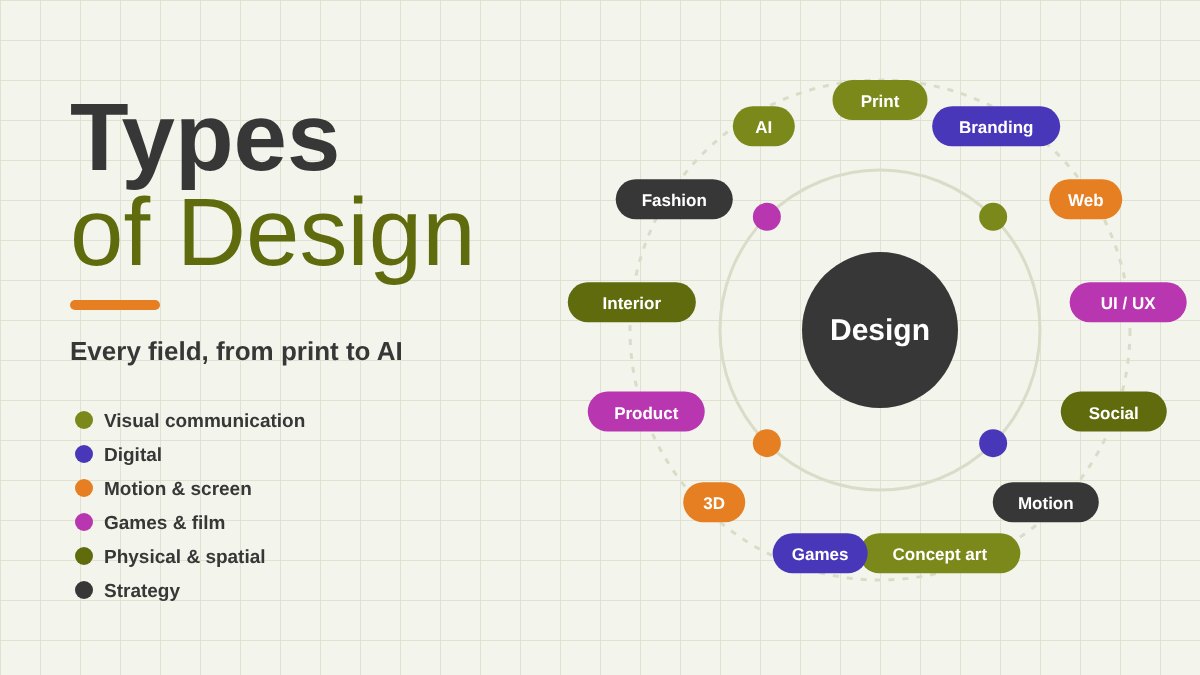
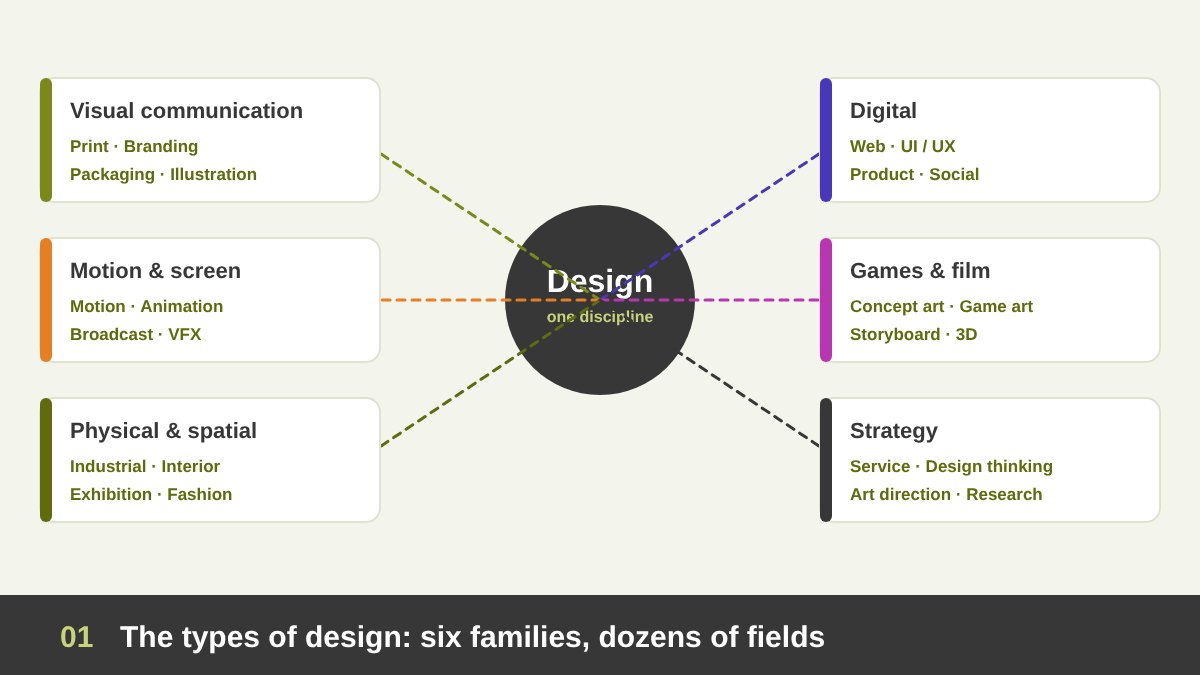
- Today the fields fall into six families: visual communication (print, branding, advertising, packaging, type, illustration, information design), digital (web, UI, UX, product, social media), motion and screen, entertainment (concept art for games and film), physical and spatial (product, interior, exhibition, fashion) and strategic (service design, design thinking, art and creative direction).
- Web design did not simply become UI/UX. UI is how a product looks and behaves on screen; UX is the whole experience, researched, structured and tested. Many designers do both, but they are different skills.
- The same principles of design (hierarchy, contrast, balance, grids, type) run through every field. What changes is the medium, the tools, the timeline and the audience.
- You do not have to choose one field forever. The strongest designers build a T shape: one deep specialism plus a working knowledge of the fields around it.
A Short History: From the Printing Press to AI
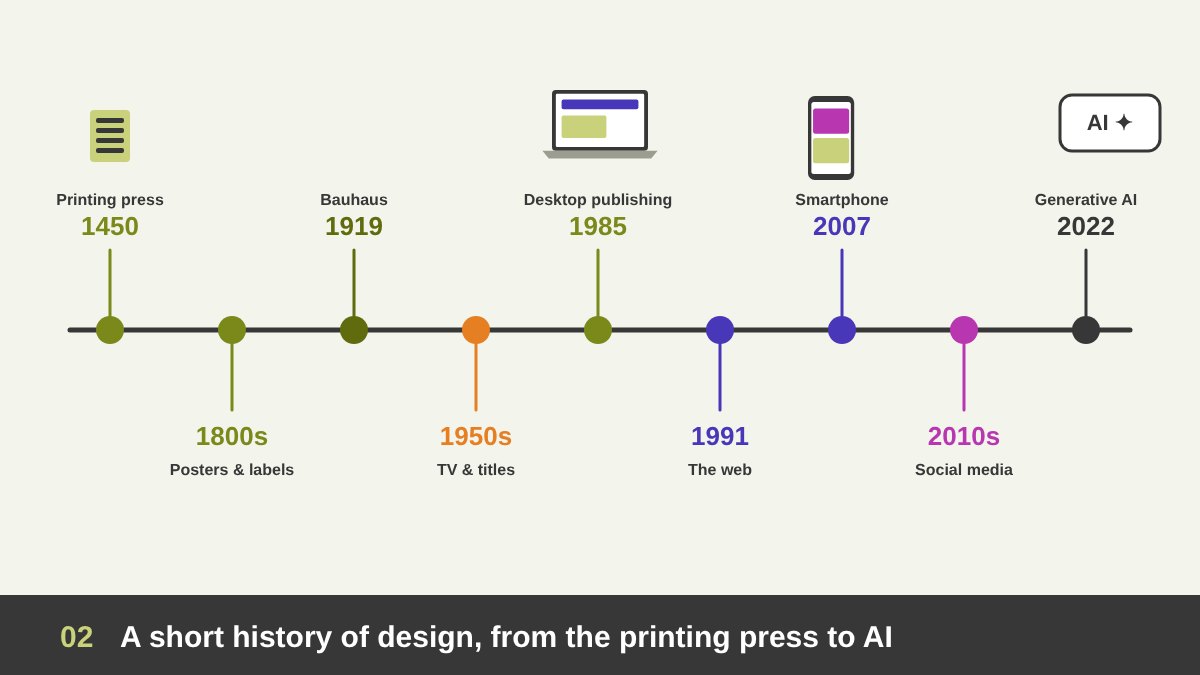
For most of history, design was not a separate job. Scribes, calligraphers, architects and craftspeople designed as part of their work. That changed around 1450, when Gutenberg’s movable type made the printed page a product, and the people who arranged letters on it became the first typographers and layout designers. The Arabic and Islamic world had its own long tradition of calligraphy, geometric ornament and book arts, which still shapes Arabic design today.
In the 19th century, lithography and the industrial revolution brought colour posters, labels, packaging and advertising to the street. In 1922 the American designer William Addison Dwiggins used the term “graphic design”, and schools like the Bauhaus (1919) taught that art, craft and industry belong together, which gave birth to modern product, furniture and interior design. After the Second World War came corporate identity programmes, the Swiss International Style and, with television, the first motion graphics and film title sequences.
Then came the computer. Desktop publishing arrived in 1985 with the Macintosh, PageMaker and laser printers, and moved design from the drawing table to the screen. The World Wide Web opened to the public in 1991, and web design was born. The term “user experience” spread in the 1990s, and the iPhone (2007) turned screens into something people touch all day, which made UI and UX design central to every business. Social media in the 2010s created a constant need for content, and since 2022 generative AI has changed how designers sketch, explore and produce, as I discuss in AI and Adobe for Graphic Designers.
Print and Editorial Design
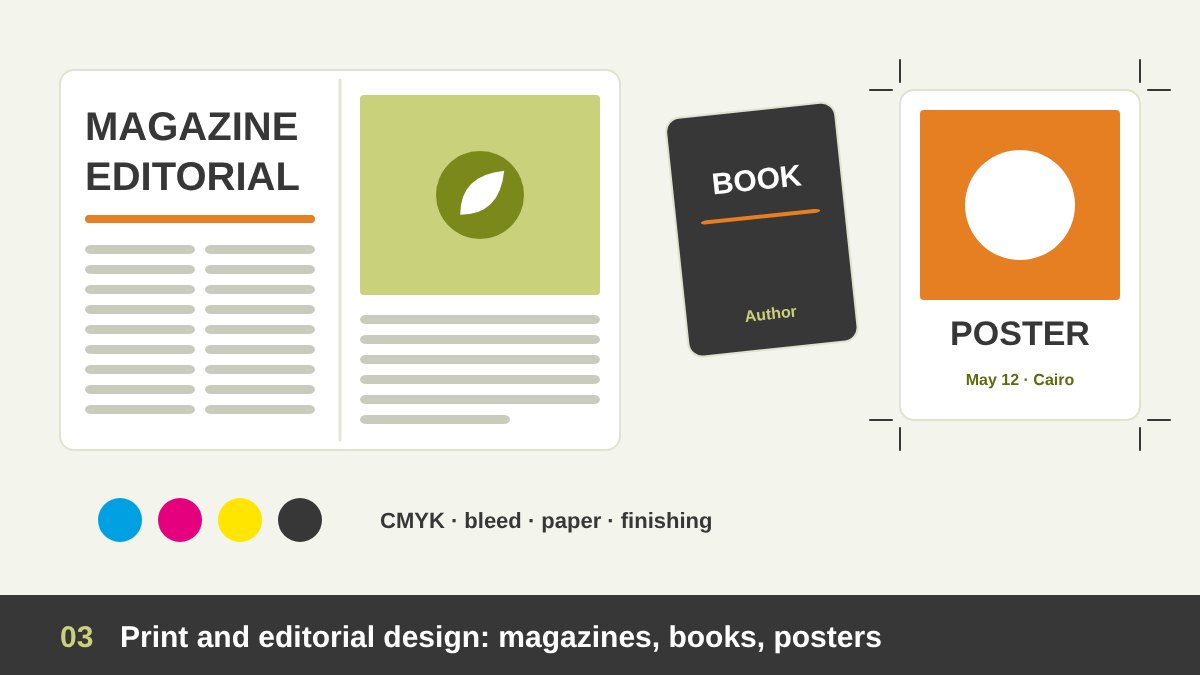
Print design is the oldest field of graphic design and still one of the most demanding. It covers everything designed to be printed: flyers, brochures, posters, catalogues, annual reports, menus, invitations and stationery. A print designer must understand paper, binding, CMYK colour, bleed, resolution and finishing (embossing, foil, spot UV), because a mistake is not fixed with an update; it is reprinted at a cost.
Editorial design is the specialised side of print that deals with long content: magazines, newspapers, books and book covers. It is about grids, typographic hierarchy and rhythm across many pages, so that a reader can move through 200 pages without getting lost. Today editorial designers also design digital magazines, e-books and long-form web articles, but the skills are the same: structure, readability and pacing.
Print has not died; it has become more premium. Brands spend less on mass flyers and more on beautiful packaging, books, printed portfolios and event materials, which is why a designer who truly understands print production is valuable.
Branding, Visual Identity and Logo Design
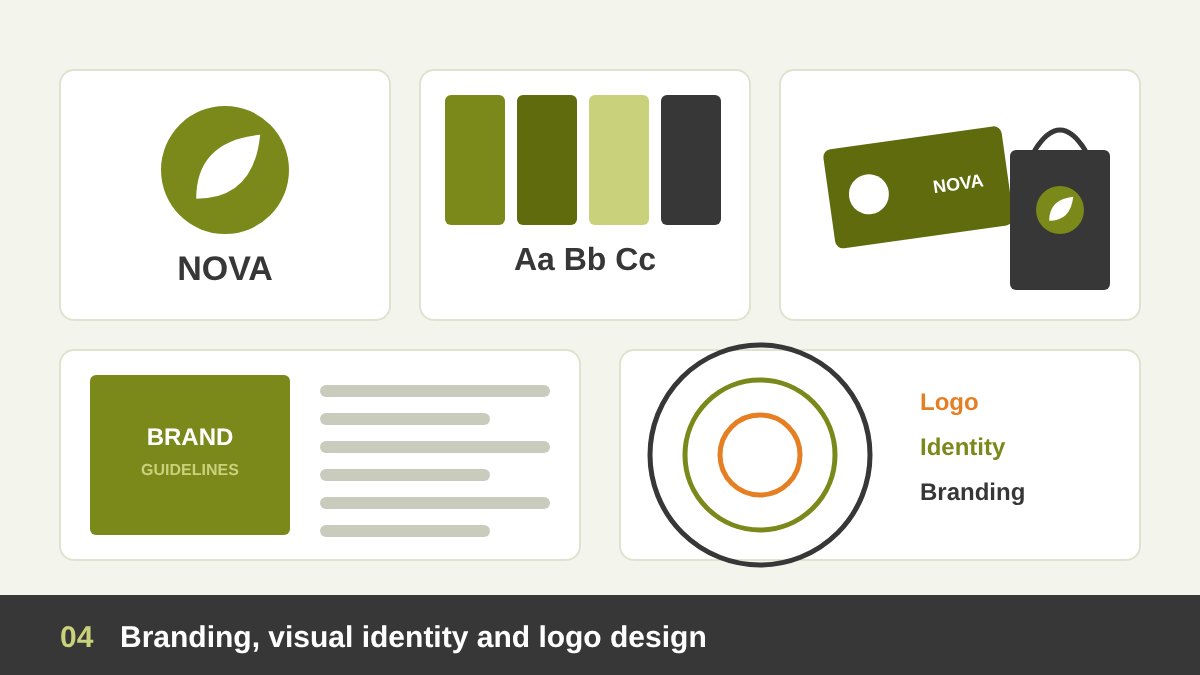
Logo design is the field most people think of first, but a logo is only the face of something bigger. A good logo is simple, memorable, works in one colour and at small sizes, and is built on a concept, as I explain in Good Logo Design. Logo design includes wordmarks, lettermarks, symbols, emblems and combination marks.
Brand identity design (or visual identity) builds the full system around the logo: colour palette, typefaces, photography and illustration style, icons, patterns, layout rules and the brand guidelines book that keeps everything consistent. Branding goes further still: strategy, positioning, naming, tone of voice and the experience a customer has at every touchpoint. The difference between these levels is the subject of Branding vs Logo Design, and you can see a full identity from concept to applications in the Al Malik case study.
Related specialisms include rebranding, naming and verbal identity, brand strategy, employer branding, personal branding and place or city branding. Branding designers work in agencies, in-house teams and as freelancers, and it is one of the best paid areas of graphic design because the work lasts for years.
Advertising and Marketing Design
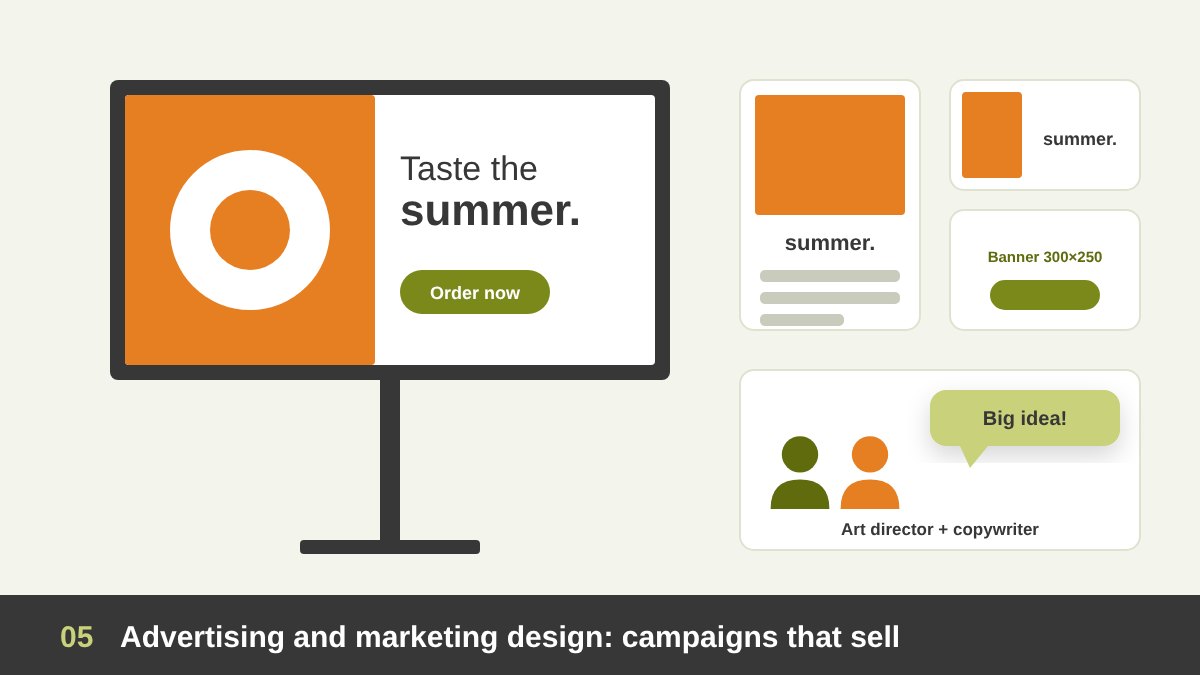
Advertising design creates visuals that sell: campaigns, press ads, billboards and outdoor (OOH), transit ads, point-of-sale displays, shop windows and digital banners. In an advertising agency the designer usually works as an art director paired with a copywriter: one owns the visual idea, the other the words, and together they create the campaign concept.
Marketing design is the everyday version inside companies: product launches, sales brochures, landing page visuals, email newsletters, trade show graphics and presentations. The work is fast and measured by results (clicks, sales, sign-ups), so marketing designers learn to test versions, adapt one idea to many sizes, and respect the brand guidelines while still catching the eye.
Two close relatives deserve a mention: email design, which has its own technical limits, and presentation design (pitch decks, keynote slides and sales decks), which has become a full speciality because one strong deck can win or lose a contract.
Packaging and Label Design
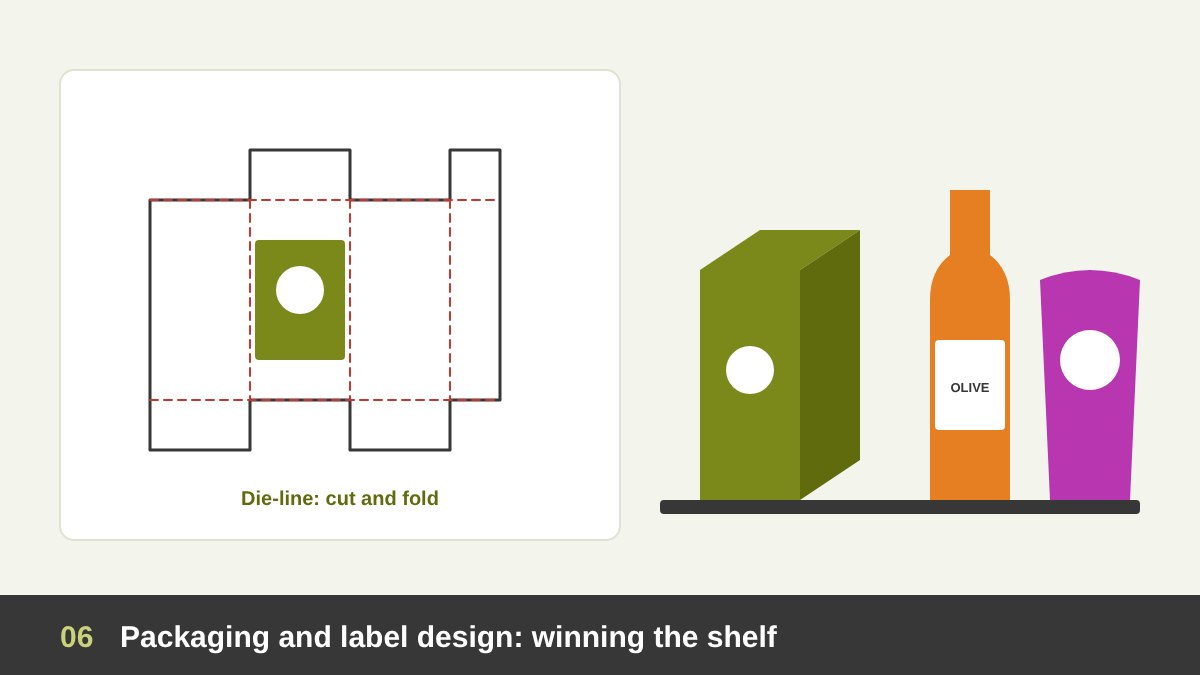
Packaging design is where graphic design meets three dimensions. A packaging designer designs the box, bottle, can, pouch or bag, and the graphics on it, so the product stands out on a crowded shelf in about three seconds, explains what it is, and survives shipping. They work with die-lines (the flat cutting template), materials, printing methods and legal information like ingredients and barcodes.
The field includes label design (wine, coffee, cosmetics), structural packaging (the physical shape and opening experience), retail and point-of-sale displays, and more and more sustainable packaging, which uses less plastic, less ink and recyclable materials. In e-commerce, the unboxing moment has become a branding tool of its own, especially when it is filmed and shared on social media.
Typography, Type Design and Calligraphy
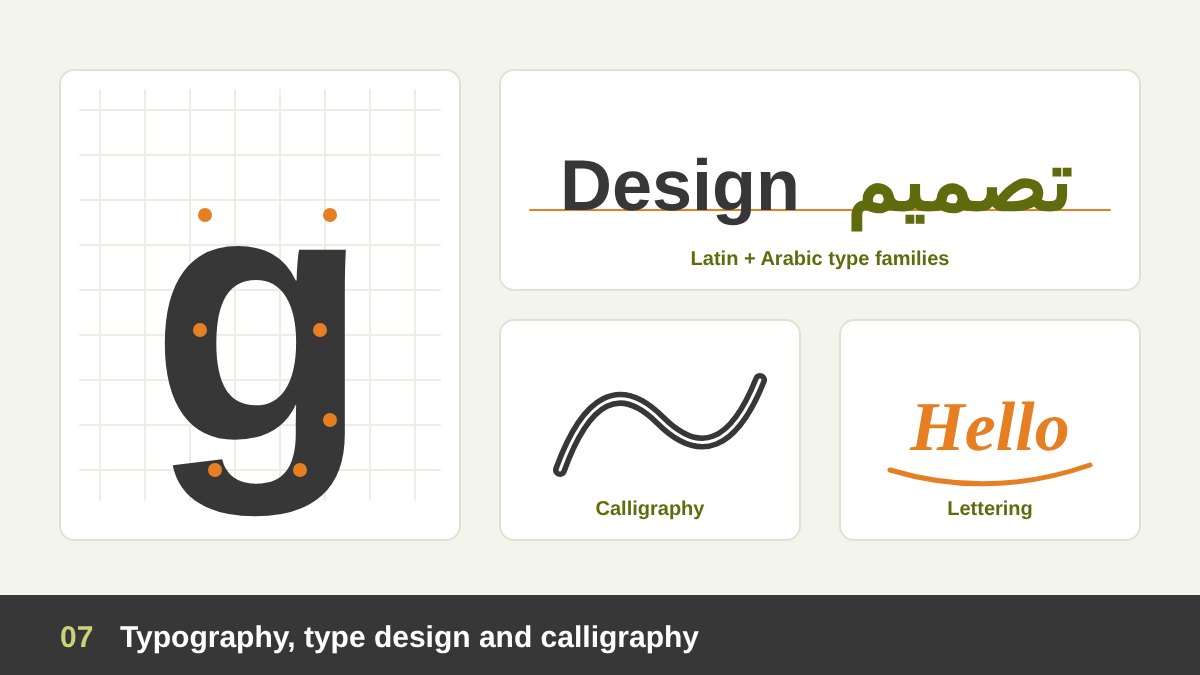
Typography is the art of arranging type: choosing typefaces, sizes, spacing and line length so text is readable and expressive. Every designer uses it, but type design is a separate profession: designing the typefaces themselves, letter by letter, in all weights, with kerning, languages and variable font axes. A professional type family can take years.
Close to it are lettering (drawing letters for one specific use, like a logo or a book cover), calligraphy (writing beautiful letters by hand, a living art in the Arab world with styles like Naskh, Thuluth, Diwani and Kufi) and multi-script type design, which is in high demand as brands need Arabic and Latin fonts that work together. Arabic type designers face their own challenges: connected letters, many letter shapes, diacritics and right-to-left layout.
Illustration: Editorial, Children’s Books, Technical and Medical
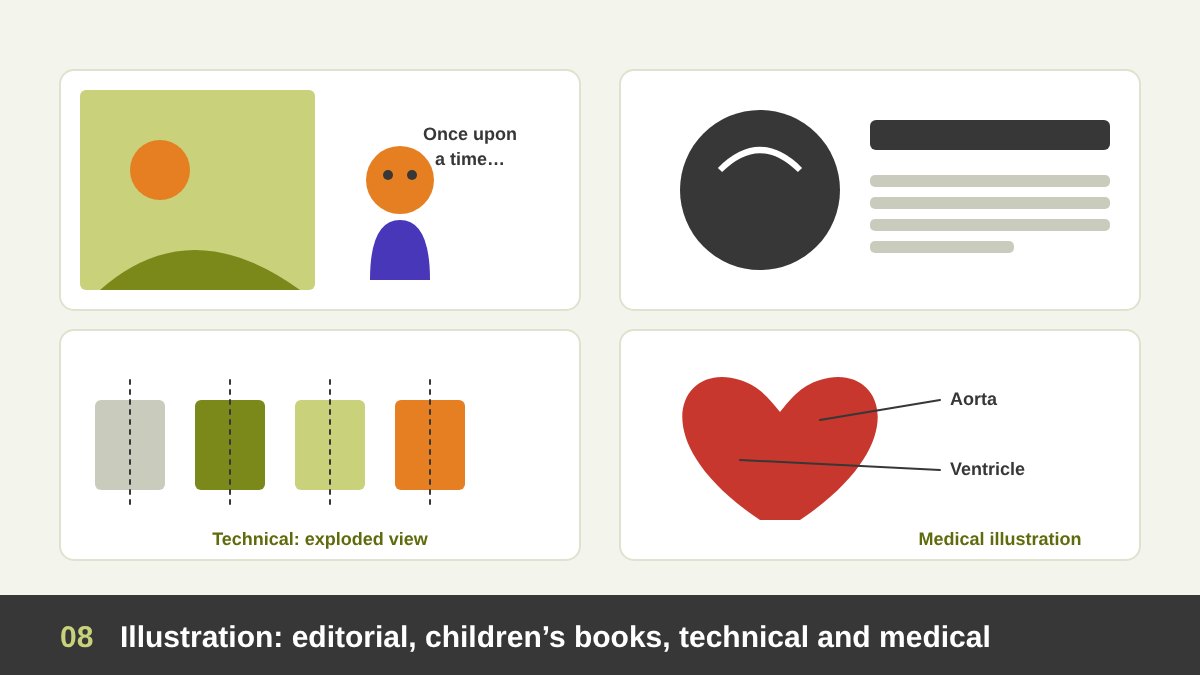
Illustration sits between art and design: it is image-making for a purpose. Editorial illustrators create images for articles and magazine covers; book illustrators work on children’s books, novels and covers; comic and graphic novel artists (including manga) tell stories in panels; and brand illustrators create a visual language for companies, from packaging to app empty states.
There are also highly technical illustration fields. Technical illustration explains how products are assembled; medical and scientific illustration shows anatomy, cells and procedures with great accuracy (often for textbooks and surgery training); architectural illustration presents buildings before they exist; and fashion illustration sketches clothing ideas. Illustrators today work both by hand and digitally, in Procreate, Photoshop, Illustrator or 3D tools.
Information Design: Infographics, Data Visualisation, Maps and Wayfinding
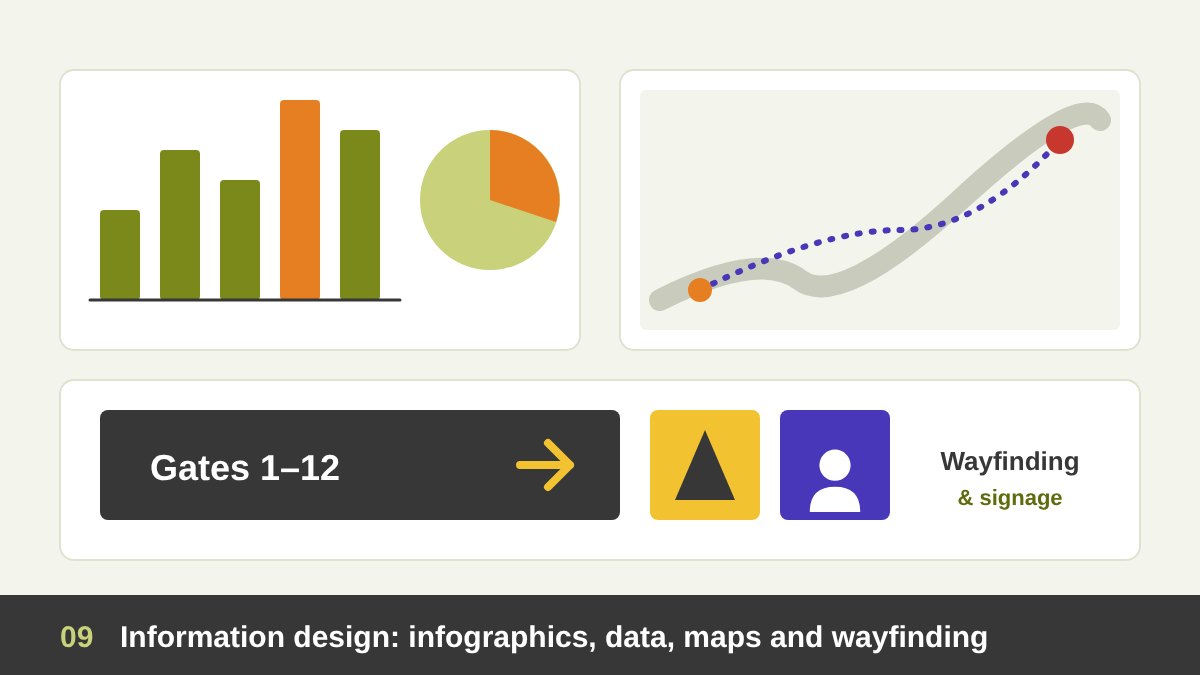
Information design makes complex information easy to understand. It includes infographics (visual explanations of a topic), data visualisation (charts, dashboards and interactive data stories), cartography and map design, timetables, instructions and forms. The goal is not decoration; it is clarity, so the designer must care about accuracy as much as beauty.
Its physical cousin is environmental graphic design: wayfinding and signage systems for airports, hospitals, malls, universities and cities, plus pictograms and the graphics on building walls. A good wayfinding system means you never think about it, because you simply find your way. This field connects graphic design with architecture, interior design and accessibility.
Web Design: From the First Websites to Responsive Design
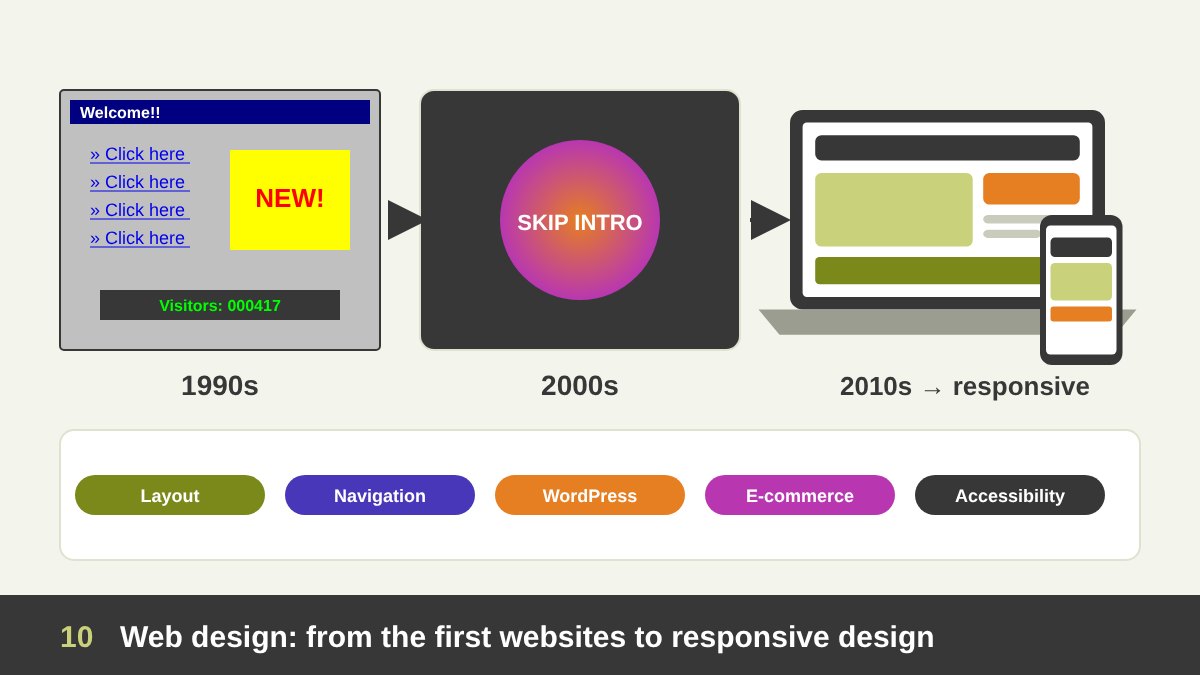
Web design was born with the World Wide Web in the early 1990s. The first sites were mostly text, blue links and small images. In the late 1990s and 2000s designers pushed the limits with tables, Flash animations and splash pages. Then came web standards and CSS, which separated content from design, and in 2010 the idea of responsive web design: one site that adapts its layout to every screen, from a large monitor to a phone.
A web designer today plans the layout, navigation, typography, imagery and interactions of websites, and often builds them with tools like WordPress, Webflow, Framer or Shopify, or hands them to a developer. Specialisms include landing page design, e-commerce design, web accessibility and front-end design, where design and code meet.
Over time web design split into more specialised roles, which is why you see far more job ads for UI and UX designers than for “web designers” today. But the web designer has not disappeared: small businesses, portfolios and marketing sites still need someone who can take a site from idea to launch.
UI Design and UX Design: What Is the Difference?
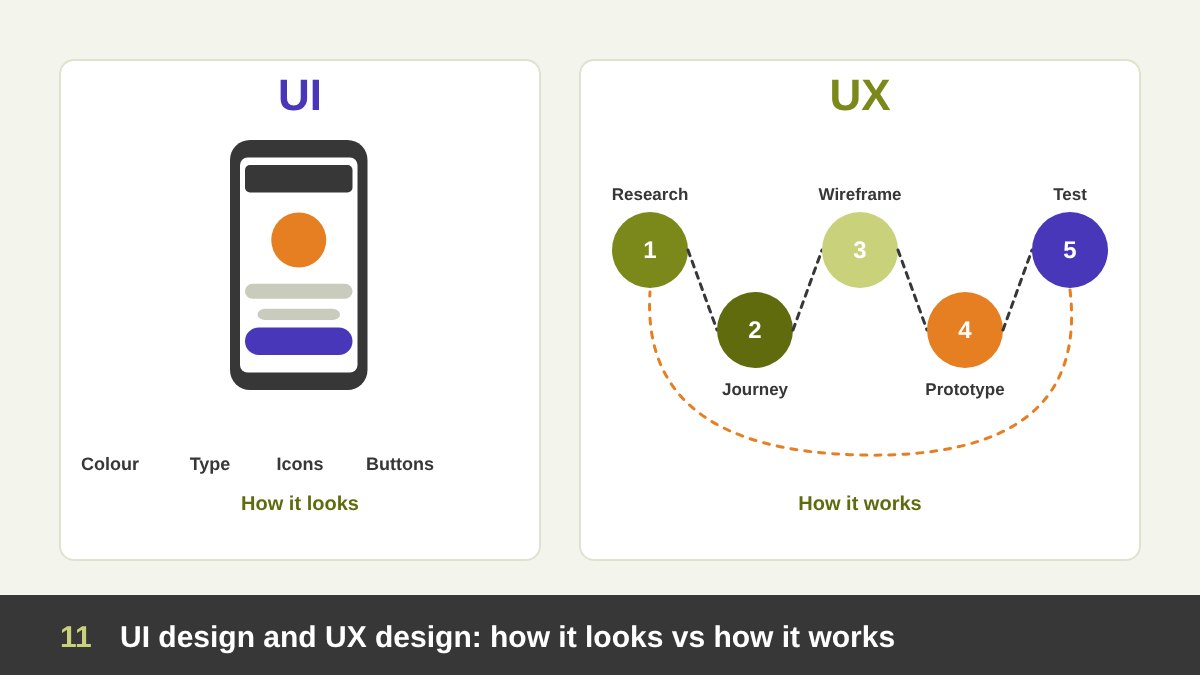
UI design (user interface) is how a digital product looks and feels: screens, buttons, icons, colour, typography, spacing, states and micro-interactions. A UI designer builds consistent, beautiful and usable interfaces, usually in Figma, and works closely with developers so the design can be built.
UX design (user experience) is broader: it is about how the product works for real people. UX designers research users, map their journeys, organise content (information architecture), sketch wireframes, build prototypes and test them, then improve the product based on evidence. A beautiful app with a confusing sign-up has good UI and bad UX. A simple one that gets you to your goal quickly has good UX.
UX has grown into a family of its own: UX research, interaction design (IxD), UX writing and content design (the words in the interface), usability testing and accessibility design. In smaller teams one person does UI and UX together; in large companies they are separate jobs. For Arabic products, both must handle right-to-left layouts properly, not just mirror the English screens.
Product Design, App Design and Design Systems
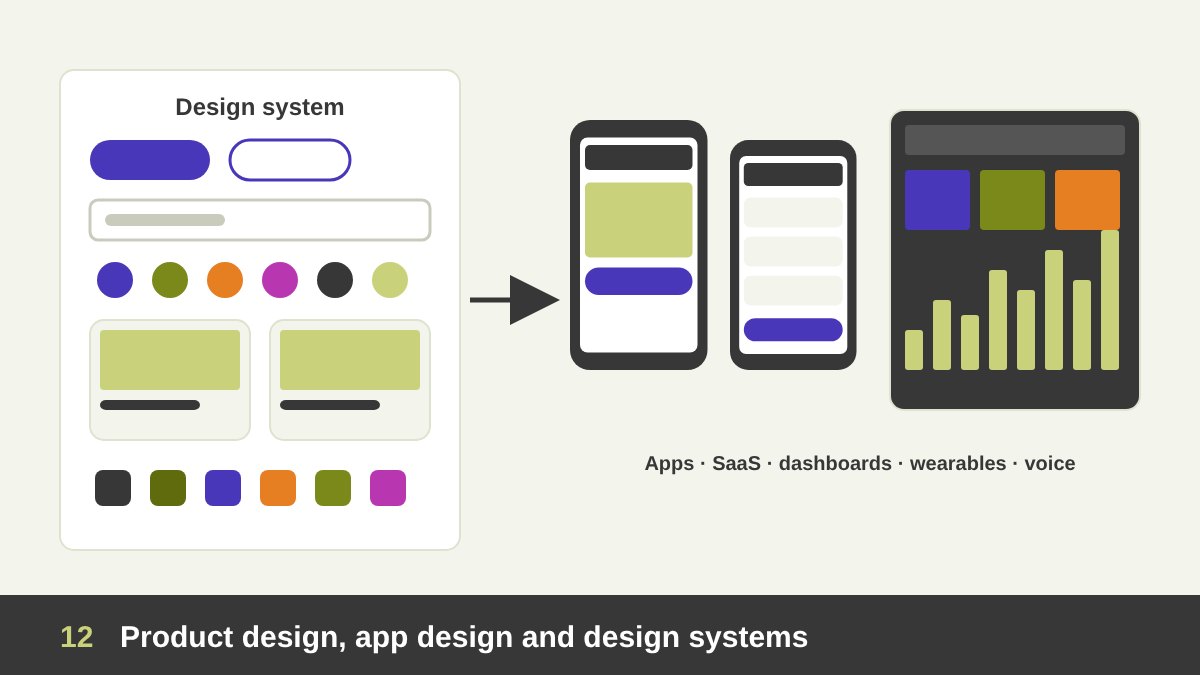
In technology companies, product designer usually means a designer who owns a digital product end to end: they understand the business goal, the user need and the technical limits, and they design, test and improve features continuously after launch. It combines UI, UX and strategy, and it is one of the most in-demand design jobs in the world. Mobile app design is a large part of it, with its own rules for iOS and Android.
As products grow, teams build design systems: shared libraries of components, colours, type and rules (like Google’s Material Design or Apple’s Human Interface Guidelines) so dozens of designers and developers can build consistently. Design system designers, DesignOps specialists and design engineers who work in both design and code are newer roles that did not exist fifteen years ago.
Other digital specialisms include dashboard and SaaS design, wearable and smartwatch design, automotive and in-car interfaces, TV and smart-home interfaces, and conversational and voice design for chatbots and voice assistants, where the “interface” is the conversation itself.
Social Media Design and Content Creation
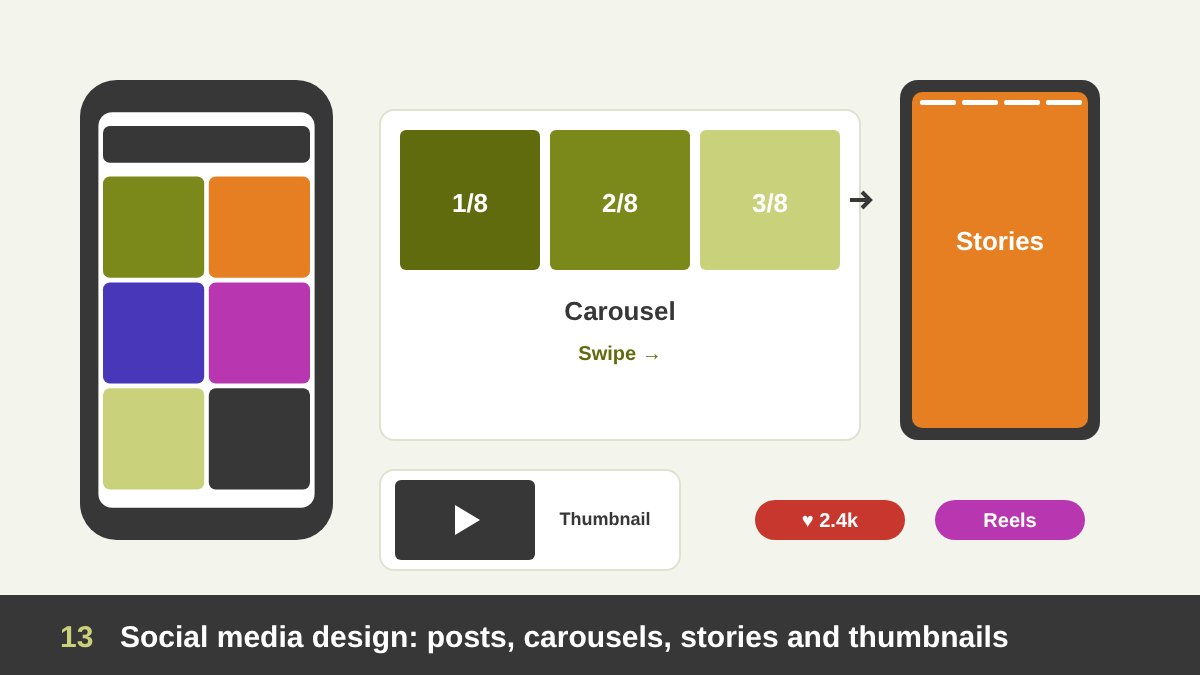
Social media design barely existed before 2010, and today it is one of the biggest sources of work for graphic designers. It includes feed posts, carousels, stories and reels covers, YouTube thumbnails, profile and cover images, ad creatives in many sizes and templates that a brand can reuse every week. The designer must think in series and campaigns, not single images, and design for a thumb that scrolls in a second.
The field overlaps with content creation: many social designers also write captions, edit short videos and animate posts, and work with a content calendar. It also overlaps with performance creative, where ad designs are tested and changed according to the numbers. The best social designers keep the brand consistent while following the fast-changing formats and trends of each platform, some of which I covered in Graphic Design Trends 2026.
Motion Graphics, Animation and Broadcast Design
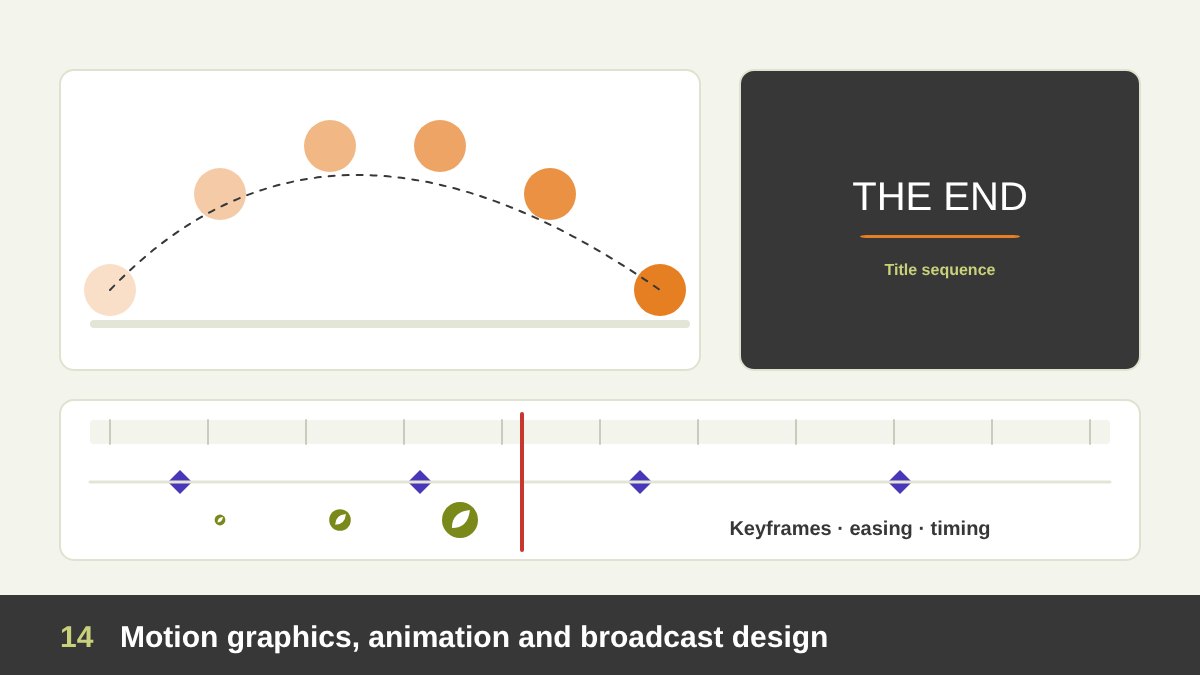
Motion graphics is graphic design that moves: animated logos, explainer videos, kinetic typography, social video, app animations and on-screen information. The field grew from film title sequences in the 1950s and television graphics, and exploded with After Effects, the web and social video. Motion designers think in time: rhythm, easing, transitions and sound.
Related fields include 2D animation (character and frame-by-frame), 3D animation, broadcast design (TV channel identities, news graphics and sports graphics), title design for films and series, VFX and compositing, UI animation and micro-interactions, and projection mapping and screens for events and concerts. Motion is now expected in almost every brand identity, because a logo lives on screens more than on paper.
Concept Art for Film, TV and Animation
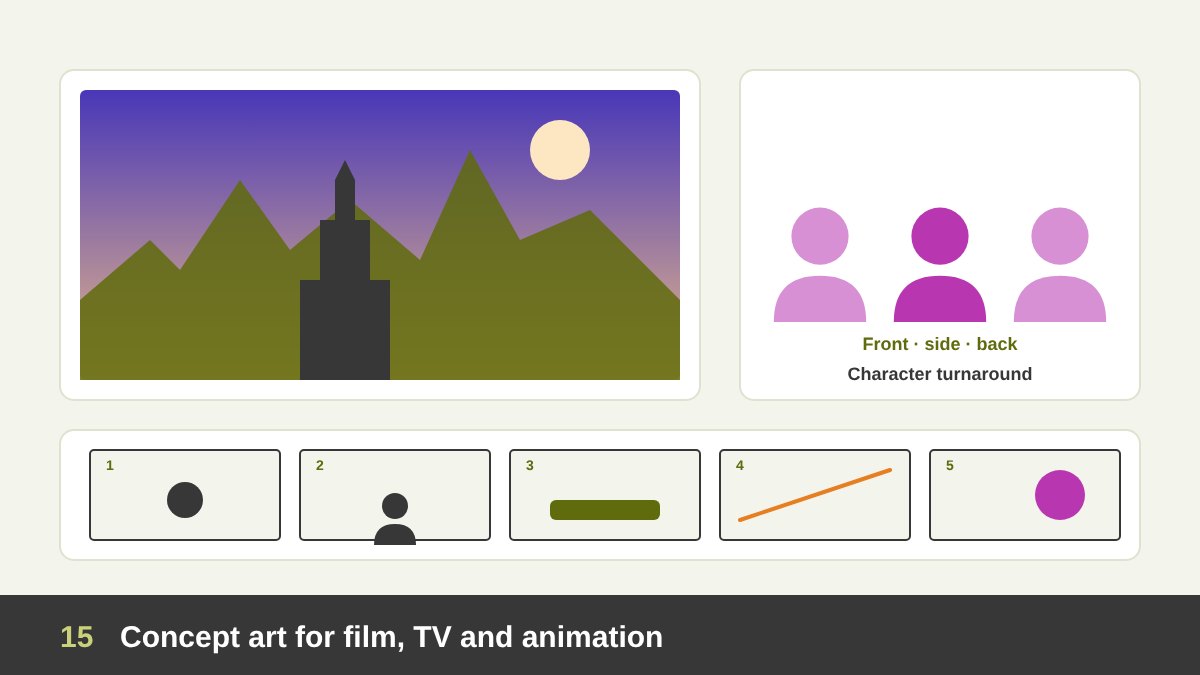
Concept art is visual development: drawing and painting ideas for worlds, characters, creatures, vehicles and props before they are built, filmed or animated. The term grew at animation studios in the 1930s, and became famous with films like Star Wars, whose look was shaped by concept paintings. A concept artist does not make the final image; they explore many options fast so the director and production designer can choose.
Around it are several specialised roles: visual development artists in animation, storyboard artists who plan each shot, production designers and art directors who own the whole look of a film or series, set designers, costume designers, matte painters who create digital backgrounds, and key art and poster designers who create the image used to market the film. Concept artists combine traditional drawing and painting skills with digital painting, photobashing and 3D.
Game Design and Game Art
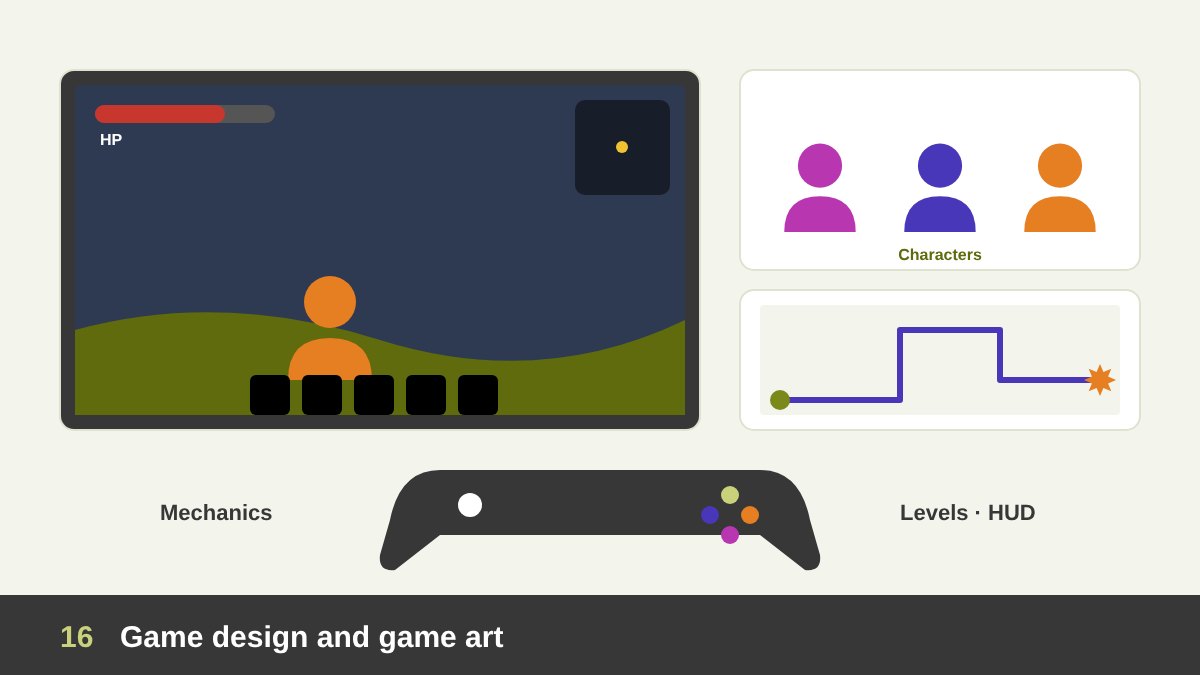
Video games are now one of the largest entertainment industries in the world, and they need many kinds of designers. Game designers design the rules, systems and mechanics: how the game plays and why it is fun. Level designers build the spaces the player moves through. Narrative designers shape the story inside the game. These are design roles in the sense of designing experiences, not images.
The visual side is game art: concept artists for characters and environments, character artists and environment artists who build them in 3D, texture and lighting artists, animators, VFX artists for magic, smoke and explosions, technical artists who connect art and code, and game UI/UX designers who design menus, inventories and the HUD (health bars, maps and icons on screen). Mobile, console and indie games all need them, and the skills overlap heavily with film and animation.
3D Design, CGI and Visualisation
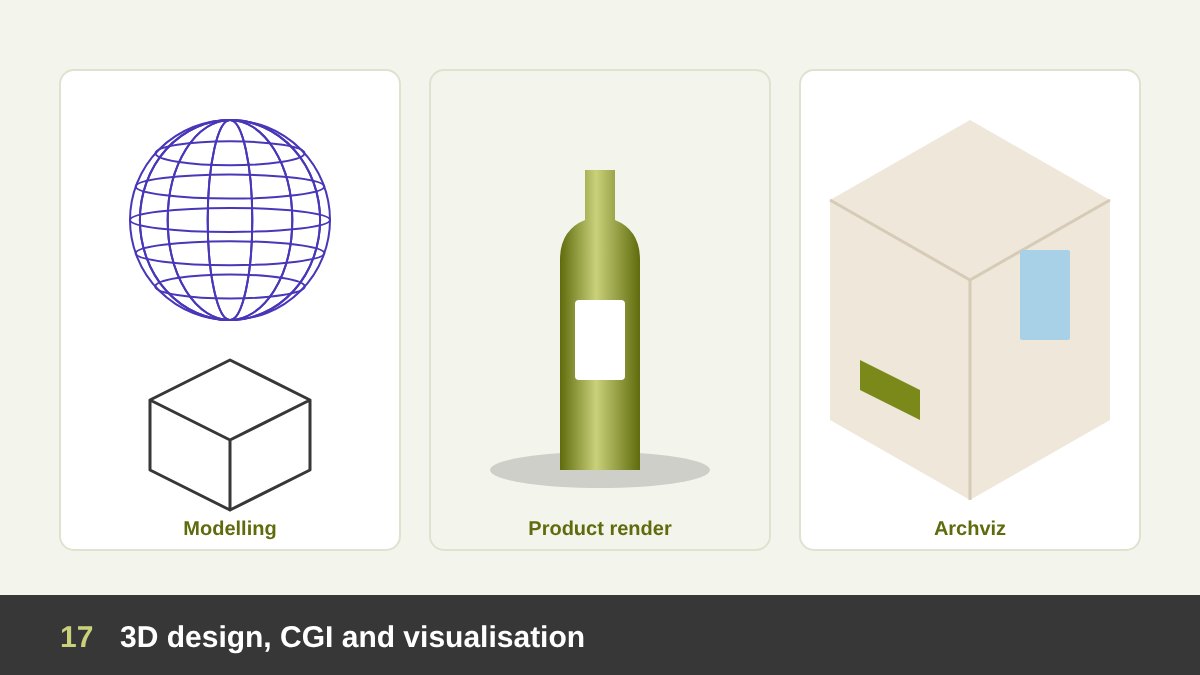
3D design started in engineering, film and games, and has now entered every corner of design. 3D modellers and CGI artists create objects, characters and scenes in tools like Blender, Cinema 4D, Maya and ZBrush. Product visualisation replaces many photo shoots: the perfume bottle or the sneaker in an ad is often a render, not a photo.
Architectural visualisation (archviz) shows buildings and interiors before they are built; 3D motion design brings brand stories to life; and 3D for the web, AR filters and virtual showrooms let customers turn a product around on their phone. Graphic designers who add basic 3D skills to their toolkit can create packaging mock-ups, typography and brand visuals that stand out.
Industrial and Product Design
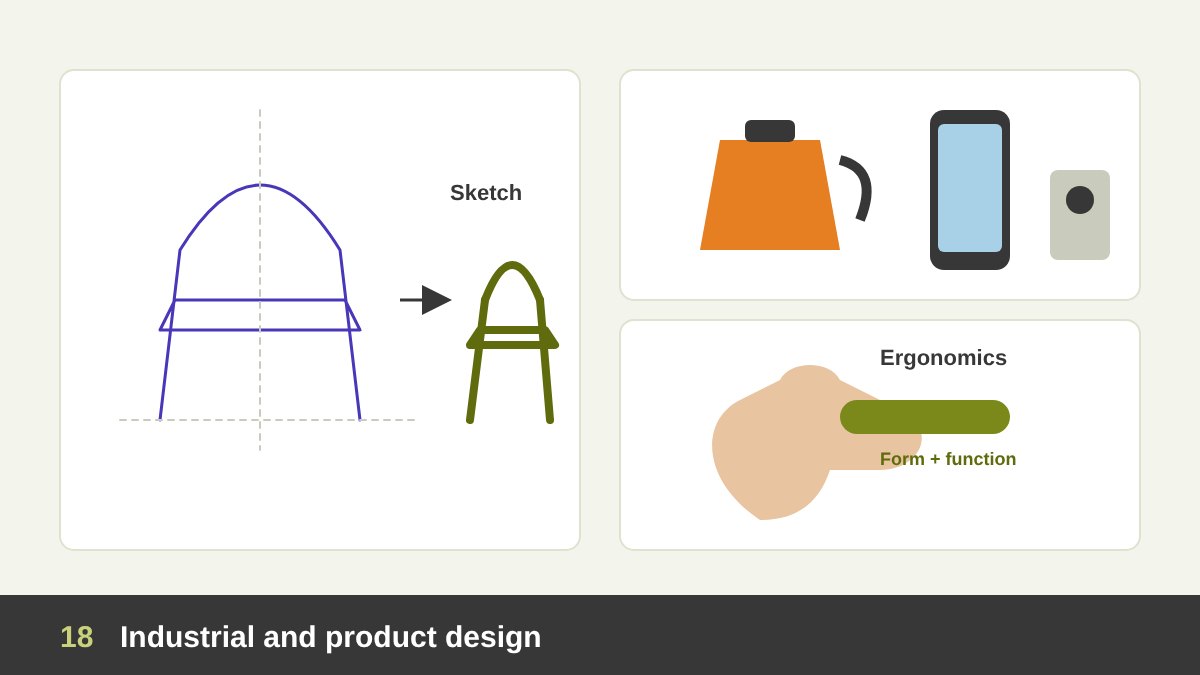
Industrial design (also called physical product design) designs the objects we use every day: furniture, home appliances, electronics, tools, cars, medical devices and toys. It was born with mass production and shaped by the Bauhaus and by designers like Peter Behrens, Raymond Loewy and Dieter Rams. An industrial designer balances form, function, ergonomics, materials, manufacturing cost and sustainability.
Specialisms include furniture design, automotive and transportation design, consumer electronics, medical device design, lighting design and toy design. The process moves from sketches and 3D CAD models to prototypes, often 3D printed, and testing with real people. It shares many methods with UX design: research, prototyping and iteration.
Interior, Exhibition, Event and Set Design
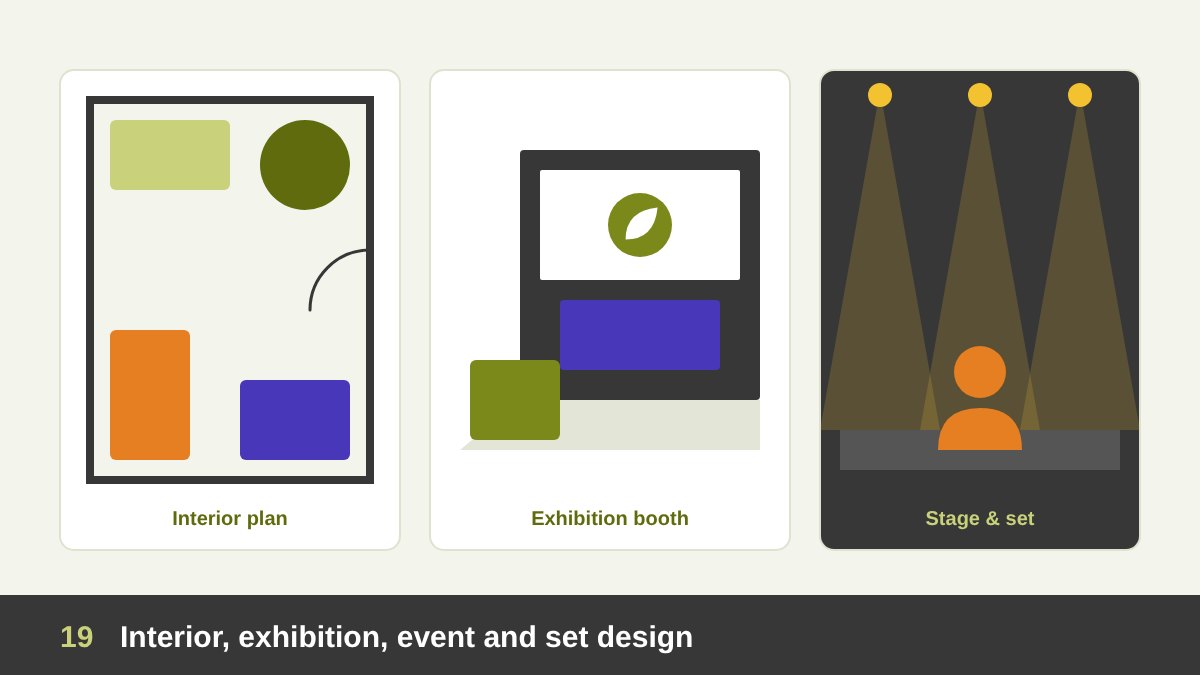
Spatial design is design you can walk into. Interior design plans the inside of homes, offices, hotels, restaurants and shops: layout, furniture, lighting, materials and colour, so the space works and expresses a feeling or a brand. Retail design and visual merchandising focus on shops and window displays; architecture, landscape design and urban design work at the scale of buildings, gardens and cities.
Exhibition and booth design creates stands for trade fairs and museum exhibitions, combining structure, graphics, screens and visitor flow; I explain the full process in Exhibition Booth Design. Event design covers conferences, launches and weddings, while set and stage design creates the worlds for theatre, TV studios, concerts and music videos. Experiential design brings all of these together with screens, sound and interaction into immersive brand experiences.
Fashion, Textile, Surface and Jewellery Design
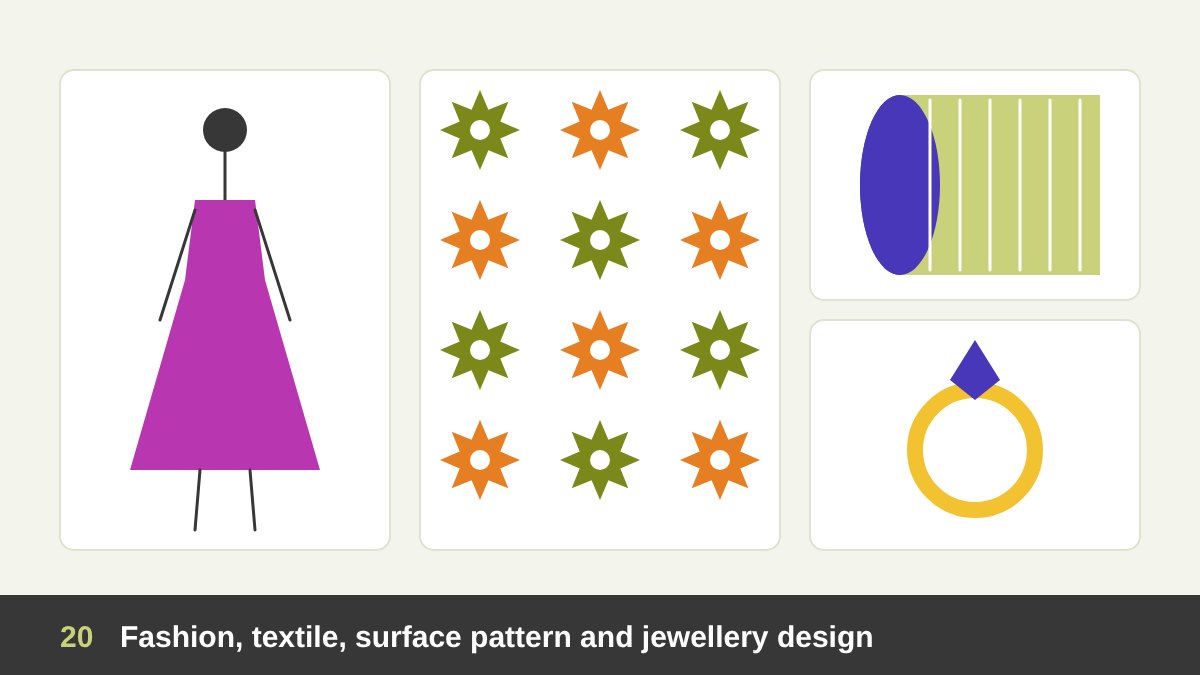
Fashion design creates clothing and accessories, from haute couture to sportswear and fast fashion. It includes footwear design, bag and accessory design, costume design for film and theatre, and technical roles like pattern making. Fashion designers work in seasons and collections, and must understand fabric, fit, manufacturing and trends.
Textile design creates the fabrics themselves, woven, knitted or printed. Its graphic side, surface pattern design, creates repeating patterns for fabric, wallpaper, tiles, stationery and packaging, and is a natural path for illustrators. Jewellery design, ceramics and glass design sit where design meets traditional craft, and they are areas where Egyptian and Arab heritage, from geometric ornament to arabesque, gives designers a rich visual language.
Photography, Video and Art Direction
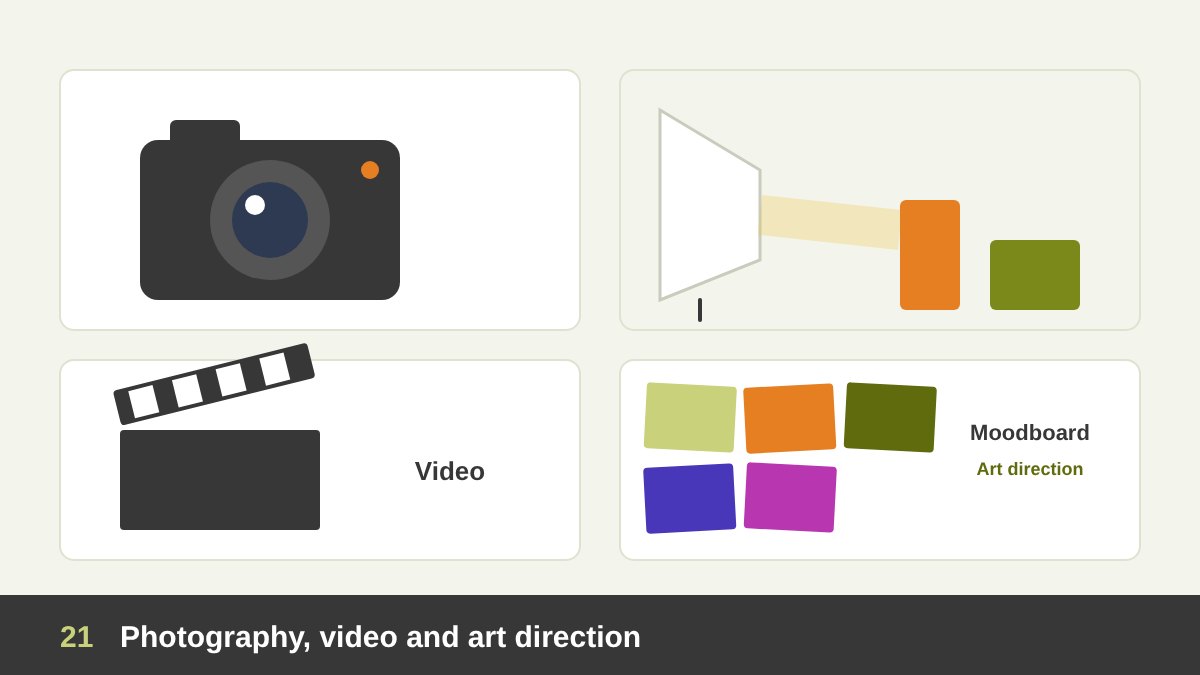
Photography and video are not always called design, but they are central to it. Commercial and product photography, food styling, fashion photography, retouching and video production create the images that branding, advertising and social media depend on. Many graphic designers also shoot and edit, especially for social content.
Holding it together is art direction: deciding the visual concept and style of a project, then guiding photographers, illustrators, designers and animators to deliver it. An art director may not touch every pixel, but owns the look and the quality. Above them, the creative director owns the creative vision across many projects and clients. I wrote about leading a design team in The Art of Managing Graphic Design, and the full career ladder is in Graphic Design Job Titles Explained.
Strategic Design: Service Design, Design Thinking and Design Leadership
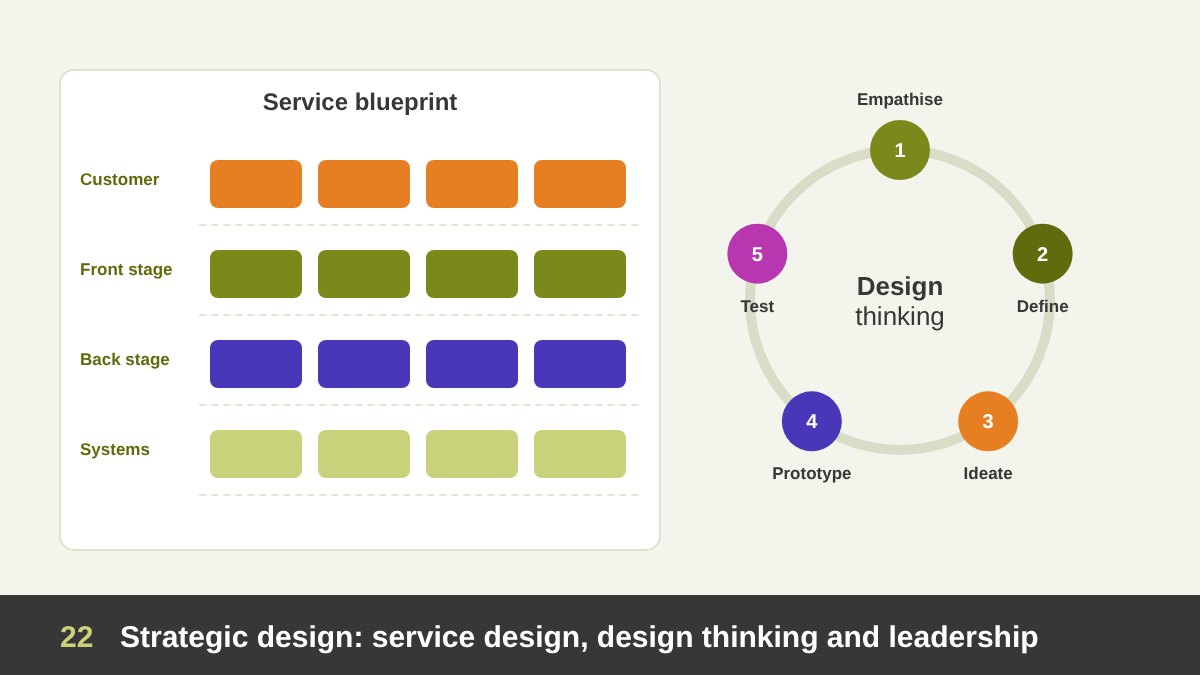
Some of the fastest growing fields do not produce a poster or a screen at all. Service design designs whole services: how a patient moves through a hospital, how a customer opens a bank account, how a passenger travels from booking to landing, across people, places and technology. Its tools are journey maps and service blueprints. Design thinking brings designers’ methods (empathy, quick prototypes and testing) into business, education and government.
Related strategic roles include design strategy, design research, innovation and futures design, social impact design, sustainable and circular design, and design management and leadership, from design manager to head of design and chief design officer. These roles need communication, business understanding and the confidence to defend good decisions, which is why knowing when to say no as a designer matters as much as craft.
New and Emerging Fields: AI, AR/VR, Creative Coding and Sound
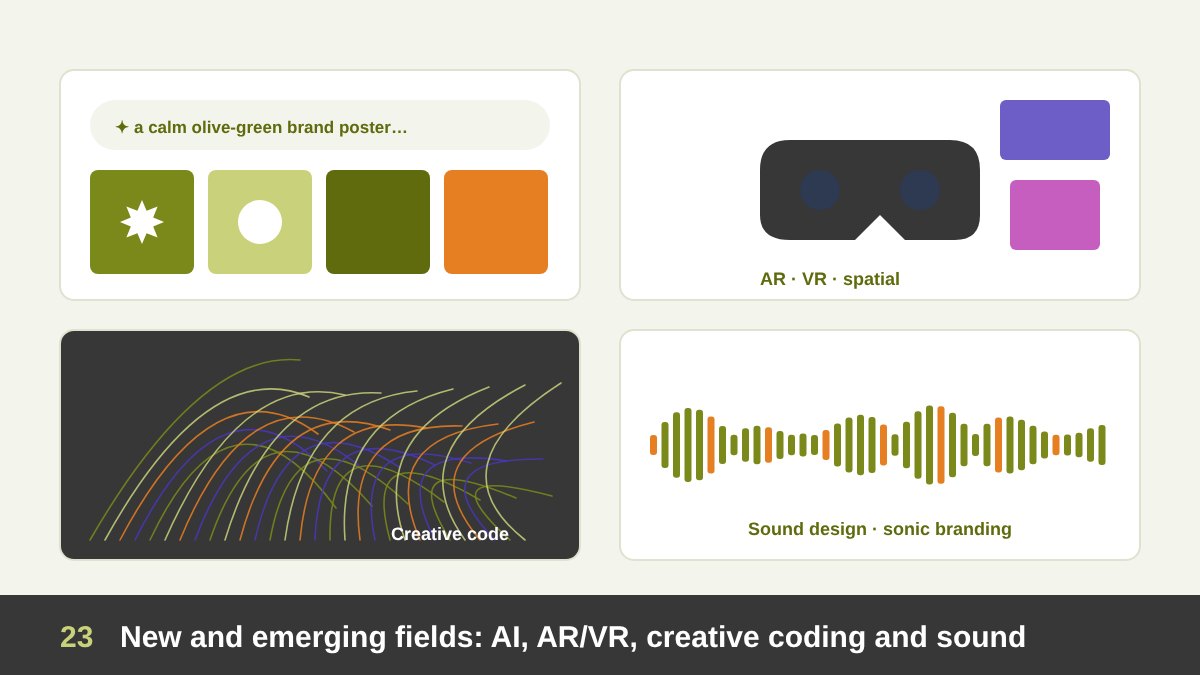
Design keeps expanding, and these fields are growing right now. AI-assisted design uses generative tools to explore ideas, produce variations and speed up production, and has created roles like AI art director and conversation designer for AI assistants. AR, VR and spatial design (XR) design experiences for headsets and augmented reality, where interfaces float in 3D space around the user.
Creative coding and generative design use code (p5.js, TouchDesigner, shaders) to create visuals, data art and interactive installations. Sound design and sonic branding design the audio side of brands and products: the notification chime, the start-up sound, the audio logo. Ethical and inclusive design is becoming a speciality too, focused on privacy, accessibility and avoiding manipulative “dark patterns”. Ten years from now there will be fields on this list that do not have a name yet.
How to Choose Your Design Field
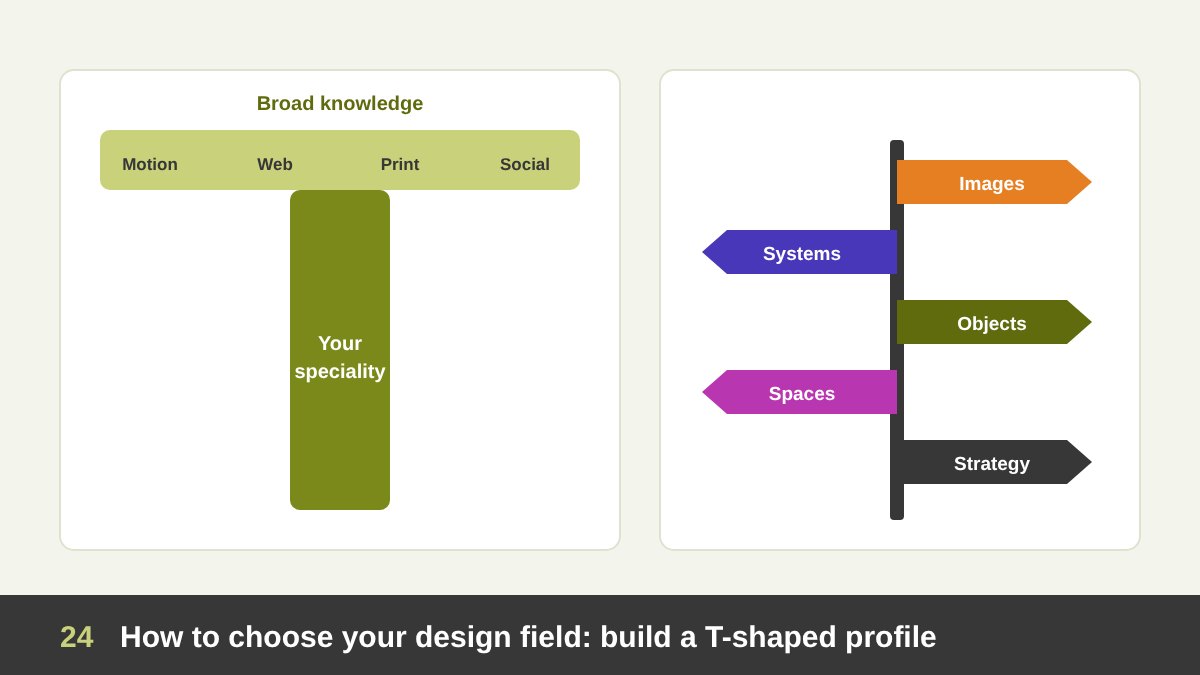
With so many types of design, choosing can feel overwhelming. Start with three questions: What do you enjoy making? (images, systems, objects, spaces, stories). How do you like to work? (alone and deep, or in teams with research and data). What medium excites you? (paper, screens, film, physical products). A person who loves drawing worlds may thrive in concept art; a person who loves solving problems and talking to users may thrive in UX; a person who loves typography and systems may thrive in branding or editorial design.
Then aim for a T-shaped profile: go deep in one field until you are genuinely good, while understanding the fields around it. A branding designer who understands motion and web, or a UI designer who understands branding and illustration, is more valuable than a specialist who cannot talk to anyone else. In my experience as an art director, the designers who grow fastest are curious about neighbouring fields and strong in the fundamentals that all of them share.
Finally, remember that your portfolio decides which field you work in, more than your degree or your job title. Build projects in the field you want, present them well (see How to Present Your Design Work) and develop the business skills from Freelance Graphic Designer Skills. You can see how one designer moves across branding, web, painting, motion and print in my portfolio, and if you need a designer for a project, get in touch. Here is every field at a glance:
| Field | What you design | Core tools | Typical job titles |
|---|---|---|---|
| Print and editorial | Brochures, posters, magazines, books | InDesign, Illustrator, print production | Graphic designer, editorial designer, layout artist |
| Branding and logo | Logos, identity systems, guidelines | Illustrator, strategy workshops | Brand designer, identity designer |
| Advertising and marketing | Campaigns, ads, banners, decks | Photoshop, Illustrator, Figma | Art director, marketing designer |
| Packaging | Boxes, labels, bottles, displays | Illustrator, die-lines, 3D mock-ups | Packaging designer |
| Type and calligraphy | Typefaces, lettering, calligraphy | Glyphs, FontLab, pen and ink | Type designer, lettering artist, calligrapher |
| Illustration | Editorial, book, technical, medical images | Procreate, Photoshop, Illustrator | Illustrator, medical illustrator |
| Information design | Infographics, data visualisation, maps, signage | Illustrator, data tools, CAD | Information designer, wayfinding designer |
| Web design | Websites, landing pages, online shops | Figma, WordPress, Webflow | Web designer |
| UI design | Screens, components, icons | Figma | UI designer, visual designer |
| UX design | Research, flows, wireframes, prototypes | Figma, research and testing tools | UX designer, UX researcher, UX writer |
| Product design | Digital products and design systems | Figma, analytics, design systems | Product designer, design engineer |
| Social media | Posts, carousels, stories, thumbnails | Photoshop, Canva, Premiere | Social media designer, content creator |
| Motion and animation | Animated logos, explainers, titles, broadcast | After Effects, Cinema 4D, Blender | Motion designer, animator |
| Concept art (film) | Worlds, characters, storyboards | Photoshop, Procreate, Blender | Concept artist, storyboard artist, production designer |
| Game art and design | Characters, environments, HUD, mechanics | Photoshop, Blender, Unreal, Unity | Game designer, game artist, level designer |
| 3D and CGI | Product renders, archviz, 3D scenes | Blender, Cinema 4D, Maya, ZBrush | 3D artist, CGI artist |
| Industrial and product | Furniture, devices, appliances, cars | Sketching, CAD, prototyping | Industrial designer |
| Spatial | Interiors, booths, exhibitions, sets | SketchUp, 3ds Max, AutoCAD | Interior designer, exhibition designer, set designer |
| Fashion and textile | Clothing, fabrics, patterns, jewellery | Sketching, CLO 3D, Illustrator | Fashion designer, textile designer |
| Photo, video and art direction | Shoots, films, visual concepts | Camera, Lightroom, Premiere, moodboards | Photographer, art director, creative director |
| Strategic design | Services, journeys, innovation | Journey maps, blueprints, workshops | Service designer, design strategist |
| Emerging | AI, XR, generative and sound design | AI tools, Unity, TouchDesigner | AI art director, XR designer, creative technologist |
Types of Design: Frequently Asked Questions
What are the main types of design?
The main types of design are graphic design (print, editorial, branding, advertising, packaging, typography, illustration and information design), digital design (web, UI, UX, product and social media design), motion design and animation, concept art and game art, 3D design, industrial and product design, spatial design (interior, exhibition and set design), fashion and textile design, and strategic design such as service design and design thinking.
What is the difference between graphic design and UI/UX design?
Graphic design creates visual communication such as logos, posters, packaging and social posts, mostly as finished images. UI design creates the interactive screens of digital products, and UX design shapes how the whole product works for its users through research, structure and testing. Many skills overlap, especially typography, layout and hierarchy.
Is web design the same as UI/UX design?
Not exactly. Web design focuses on designing and often building websites. UI and UX design grew out of web design as digital products became more complex, and they apply to apps, software and devices as well as websites. A web designer usually does some UI and UX work, but large teams split them into separate roles.
What is concept art?
Concept art is the visual development of ideas for films, animation, TV and video games: worlds, characters, creatures, vehicles and props drawn or painted before they are built. Concept artists explore many options quickly so the director or art director can choose the final look.
Which type of design is most in demand?
Demand changes by market, but in recent years product, UI and UX design, motion design, social media and marketing design, and branding have been among the most in-demand fields worldwide. AI-related design roles and 3D skills are growing quickly. Whatever the field, strong fundamentals and a focused portfolio matter most.
Can one designer work in more than one field?
Yes, and many do, especially freelancers and designers in small teams. The best approach is to be strong in one main field and comfortable in two or three related ones, such as branding with motion and web, or UI with illustration. The principles of design are the same across all of them.
Leave a Reply